
Most specifiers arrive at this comparison from one of two directions. Either a client has seen a zellige wall and wants to know what separates it from a ceramic tile with a similar glaze, or the value engineering exercise has already started and someone needs to explain what would actually be lost. Both deserve a straight answer.
Zellige, machine-made ceramic and the standard subway tile are all fired clay with a glaze on top. That is where the similarity ends. What separates them is not the recipe but the number of decisions made by hand, and every one of those decisions leaves a trace you can see from across a room.
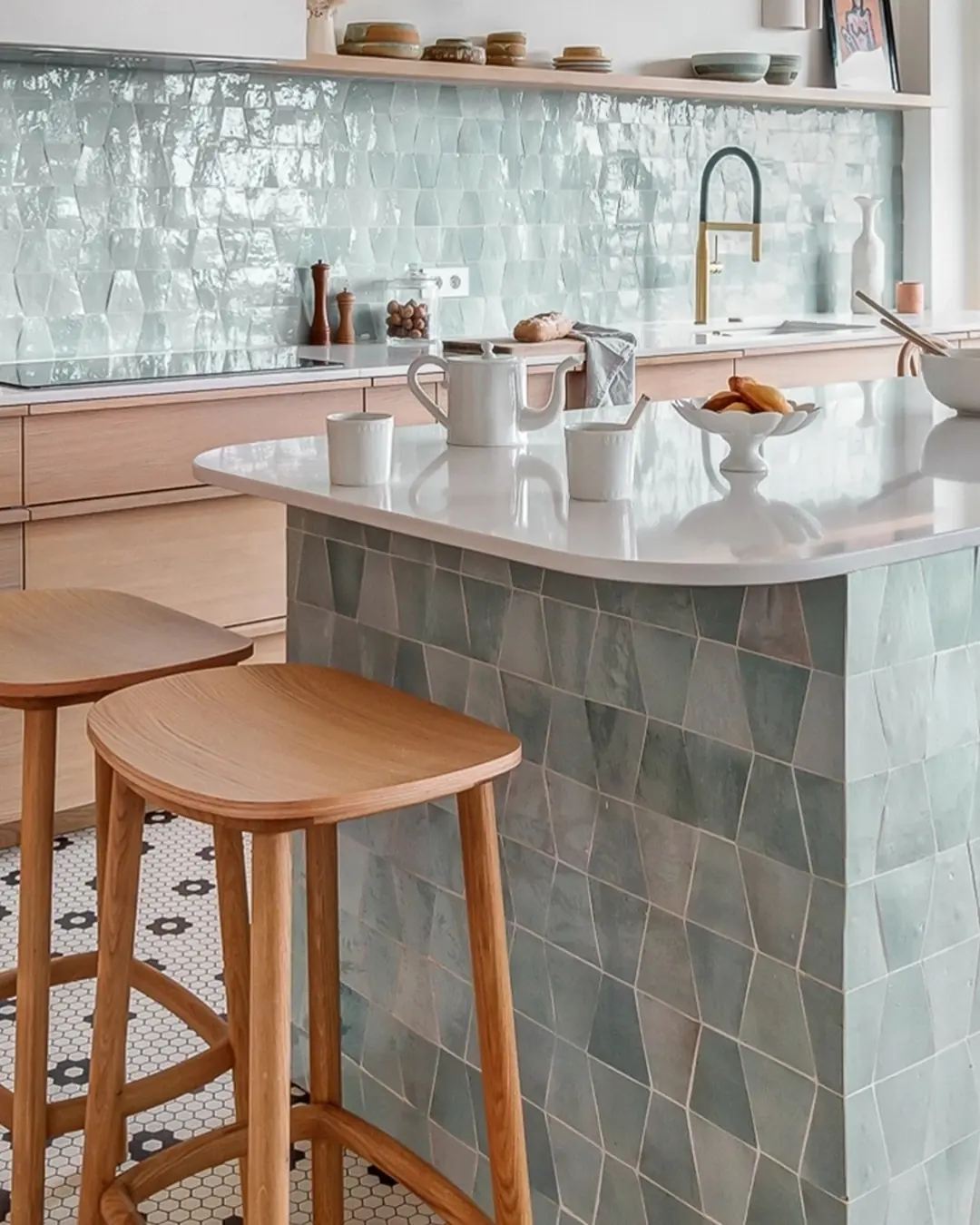
The hand is the variable, not the clay
A machine-made ceramic tile is pressed, glazed and fired to a tolerance. Its purpose is repetition: the hundredth tile out of the line should be indistinguishable from the first, because that is what makes it fast to lay and cheap to produce. Every part of the process is tuned to remove variation.
Zellige is made the opposite way round. The clay is worked wet, shaped, dried in the sun, glazed by hand and fired, then cut to its final size by a craftsman with a hammer and a sharpened edge. Each of those stages introduces small differences – in thickness, in edge, in how heavily the glaze sits. The result is a tile that is recognisably one of a family rather than one of a batch.
Subway tile occupies a third position worth naming, because it is the comparison clients reach for most often. It is a format, not a material: a rectangular tile in a running bond, usually machine-made, occasionally handmade. When someone says they want “a subway look for less”, they are usually describing the layout, not the surface. That distinction is useful in a meeting, because the layout is easy to keep and the surface is the thing actually under discussion.
How each one behaves on a wall
The practical difference shows up in light. A machine tile has a flat, even glaze, so it reflects light in a single plane – the wall reads as one continuous colour, and the grout lines read as a grid drawn on top of it.
A hand-glazed tile does not have a single plane. Each tile sits at a slightly different angle, the glaze pools a little differently, and the surface catches light unevenly. Move along the wall, or let the sun move across it during the day, and the colour changes as you go. This is the whole reason zellige is specified. It is also the reason it photographs so well and why a flat sample board tells you almost nothing – you have to see a panel of it, lit.
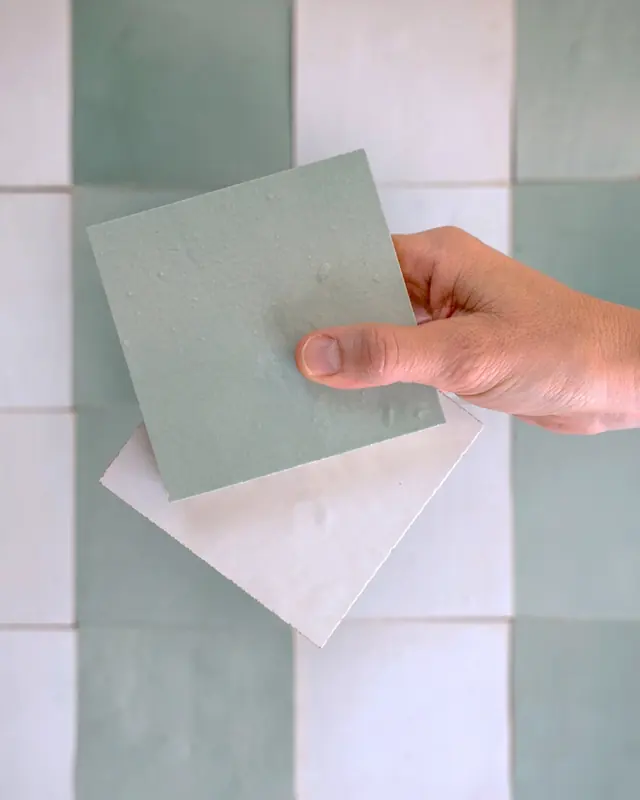
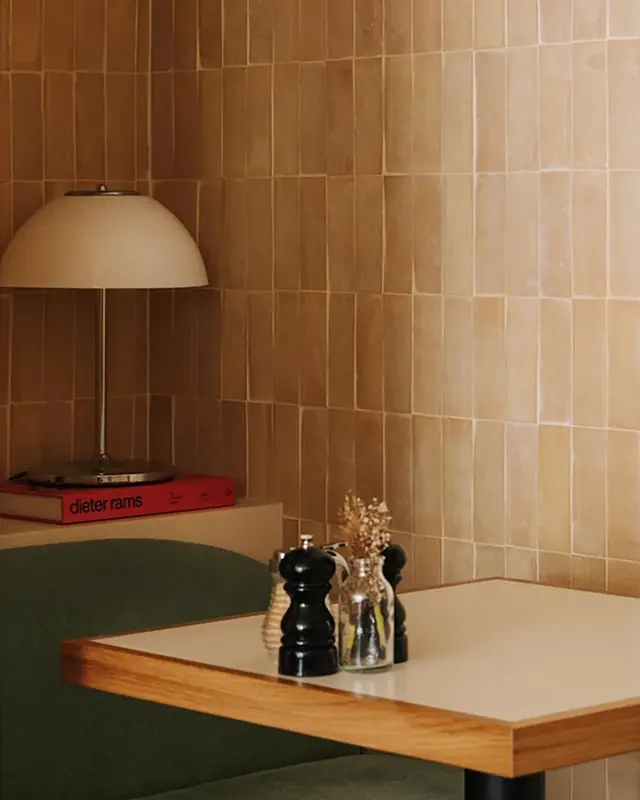
What changes on site
This is the part that gets missed at specification stage and causes trouble later.
Machine tile is set out from a drawing. The tiles are square, the joints are consistent, and the setting-out lines can be trusted. A competent tiler can work from a layout plan without much interpretation.
Handmade tile has to be set out on the wall. Tiles vary slightly in size and shape, so the joints absorb that variation rather than staying uniform; a wall of zellige laid with a rigid, machine-tile mentality will look forced. The installer needs to be mixing tiles from several boxes as they go, reading the panel as it builds, and making judgement calls about which tile goes where. That is a different skill, and it is worth confirming your tiling contractor has it before the material arrives on site rather than after.
It also changes the conversation about quantities. Because handmade tile is cut and sorted by hand, a proportion of any delivery will be used for cuts and blending rather than laid whole, and colour is matched across a single production run rather than across time. Plan the whole area in one go.
The short version for a client meeting
Machine tile buys you predictability: consistent size, consistent colour, faster installation, easy replacement. Zellige buys you a surface that moves with the light and cannot be reproduced by printing. Neither is a better tile. They answer different questions, and on most projects there is room for both.
Where the machine tile is the right answer
There are places we would not argue for zellige, and saying so tends to make the rest of the specification more credible.
- Back of house. Kitchens, prep areas, service corridors and plant rooms want a surface that wipes down and can be replaced identically in five years.
- Large uninterrupted floor areas under heavy traffic. If the brief is a hard-wearing floor, the honest Moroccan answer is not zellige – it is bejmat, which is a different, thicker, kiln-fired terracotta made for exactly that. Zellige underfoot has a narrower set of uses.
- Where identical replacement matters more than appearance. Rental turnover, phased refurbishments across many years, anywhere the client will need to patch a section and expect it to disappear.
- Where the budget will only stretch to one gesture. A small, well-placed panel of the real material almost always outperforms a large area of an imitation. Concentrate it.
A practical way to decide
Work from the surface outward rather than from the budget inward. Ask what the wall is doing in the scheme. If it is background – a surface that needs to be clean, quiet and unremarkable – machine tile does that job well and there is no reason to over-specify it. If the wall is meant to be the thing people notice, the thing that makes the room feel made rather than fitted out, the handmade surface is the only one that delivers it, and it will not read as such in a small sample.
Then check the brief for the word that matters: texture. It appears in almost every hospitality design narrative, and it is the one quality a printed or pressed tile cannot manufacture. If the narrative depends on it, the material has to earn it.