The material

How zellige
is made

Clay from the ground outside Fès, worked wet, dried in the sun, glazed by hand, fired, and then cut one tile at a time with a hammer. Every stage leaves something you can see in the finished wall.

Guide Zellige 7 min read

There is a reason the process is worth knowing rather than just admiring. Almost every question a specifier asks about zellige – why the colour shifts across a wall, why two deliveries are never identical, why a tiler needs to blend from several boxes, why an edge is never perfectly straight – is answered by something that happens in a workshop in Fès before the material ever reaches a project.

What follows is the sequence. It has not changed much in several hundred years, which is the first thing worth understanding about it: nothing here has been industrialised, because every attempt to industrialise it produces a different material.
The sequence

Six stages, all by hand

Each one introduces variation. That accumulation of small differences is what people are actually specifying when they specify zellige.

01

The clay

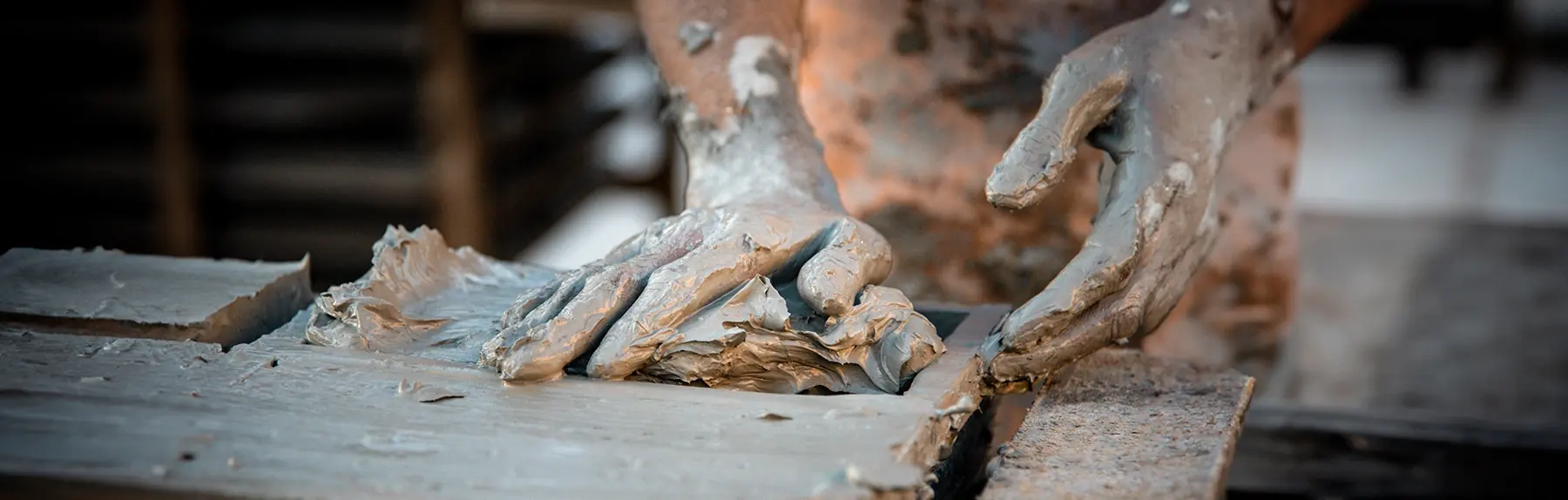
Grey natural clay is dug locally, cleaned of stones and organic matter, then kneaded with water until it is plastic enough to work. It is not refined or standardised the way an industrial body is, which is where the character begins – and why the finished tile holds colour with a depth that a uniform body does not.

02

Shaping and drying

The clay is pressed into simple wooden moulds by hand to form a rough square, then laid out to dry in the open air. Sun-drying is slow and uneven by nature, and it is the first point at which two tiles made on the same morning start to differ from one another.

03

The first firing

The dried tiles are stacked into a traditional kiln and fired. Temperature is not uniform through a kiln load, so where a tile sat affects how it comes out. This is the stage that turns clay into a ceramic body and sets the tile’s final character.

04

Glazing

Glaze is applied by hand, tile by tile. A hand-applied glaze does not sit at a constant thickness – it pools slightly, thins at an edge, catches a high point – and it is this unevenness, more than anything else, that makes a zellige wall change as you move along it.

05

The second firing

The glazed tiles go back into the kiln so the glaze vitrifies onto the body. Colour is decided here rather than at the glazing bench: a glaze goes into the kiln one colour and comes out another, which is why colour development always has to be proved by firing rather than by mixing.

06

Cutting

The fired tile is finally cut to size by a craftsman – the maalem – working with a hammer and a sharpened edge, chipping the tile down against his own eye rather than a jig. The glazed face is worked from the back so the cut edge bevels slightly inward. That bevel is why a zellige wall catches a line of shadow at every joint.

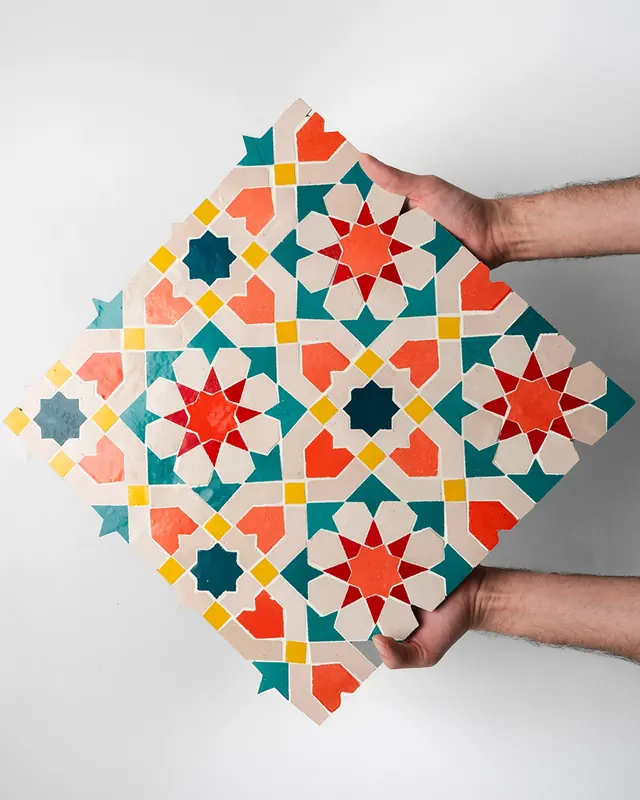
The cutting stage is also the mosaic stage. The same hand and the same hammer produce the star, cross and interlocking shapes of traditional zellige panels – a set of cut forms assembled face-down into geometry, then backed and lifted into place.

Zellige tiles laid out in rows in a Fès workshop during production
Nothing in the sequence has been mechanised, because mechanising it produces a different material.
Craft of Medina · Fès

What each stage leaves behind

Read back through the sequence with a finished wall in mind and the connections are direct.

  • The uneven edge comes from cutting by hand at stage six. It is why joints between zellige tiles are never perfectly parallel, and why the joint is part of the design rather than a technicality – a point we take further in choosing grout colour.
  • The shifting colour comes from stages four and five: a hand-applied glaze and an uneven kiln. It is also why a single tile is a poor sample and a panel is a good one.
  • The luminosity comes from the glaze sitting on a slightly irregular surface, so light reflects at many angles instead of one. Printed tiles reproduce the pattern of zellige but not this, because it is a property of the surface rather than the image.
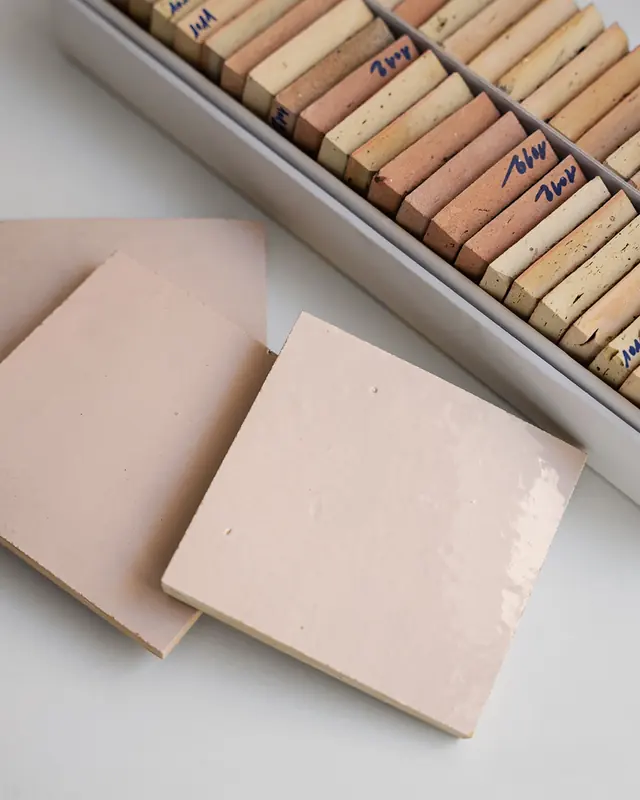
  • The eighty-six glazes in our zellige range are each a recipe proved by firing rather than mixed to a number, which is why every one of them is photographed as fired.
  • The variation between deliveries comes from every stage at once. Colour is consistent within a production run and cannot be guaranteed identical across runs made months apart – which is a planning consideration rather than a defect, and one we set out in why zellige colour varies between batches.
Racks of glazed zellige tiles in many colours drying in a Fès workshop
Glazed tiles between firings. Colour at this point is not yet the colour it will be.
Hands holding a hand-cut zellige panel of red, teal and yellow stars set into white
A cut panel. Every shape here was chipped from a fired tile by hand, against the eye.

Why it has not been industrialised

It could be. Pressed, digitally printed tiles imitating zellige exist in volume, and some are convincing in a photograph. What they cannot reproduce is the behaviour: a printed tile has a fixed image, so every tile carries the same variation, repeated. Walk along a wall of it and the repeat becomes visible, because the eye is very good at finding a cycle.

Hand production has no cycle. There is no master tile and no repeat length, so at any distance the wall reads as a continuous field rather than a pattern. That is the property being bought, and it is the one thing the process cannot be shortened without losing.

It also explains why the trade still runs through workshops rather than factories. The skill lives in the hands of the people doing the shaping, the glazing and the cutting, and it takes years to build. Working directly with those workshops – rather than through a chain of intermediaries – is what makes custom colours and custom shapes possible at all, which is the subject of sourcing Moroccan craft for GCC projects.

What is zellige made from?

Natural clay, dug locally around Fès, shaped and dried, then fired, glazed and fired again. The glaze colours come from mineral pigments. It is a ceramic in the broadest sense, but the body is unrefined in a way an industrial ceramic body is not.

Why is every zellige tile different?

Because six consecutive stages are done by hand or in a non-uniform kiln, and each one introduces a small difference. Those differences compound. It is not a tolerance failure – it is the intended result of a process that has never had uniformity as its goal.

Is zellige still made this way today?

In the Fès workshops, yes. The clay is still dug locally, the tiles are still cut by hand, and the skill still passes between generations within families. Machine-made tiles that imitate the appearance exist, but they are a different product made by a different process.

Enquiries

Made in our own
workshops in Fès

Every stage above happens within our own artisan network, which is what makes custom colours, custom shapes and hand-cut panels possible for a project rather than only for a catalogue.