
The hammam is the oldest continuous use of this material. Long before zellige reached a designer’s mood board it was lining steam rooms, plunge pools and washing chambers – rooms that are hot, wet and in constant use. So the question is rarely whether zellige belongs in a wet area. It is whether the wet area around it has been designed properly.
That distinction matters because most problems attributed to handmade tile in showers are not tile problems. They are falls, substrate, movement, waterproofing and detailing problems that a uniform machine tile would have masked slightly longer before failing in the same way.
Working through the wet area, zone by zone
The wet wall
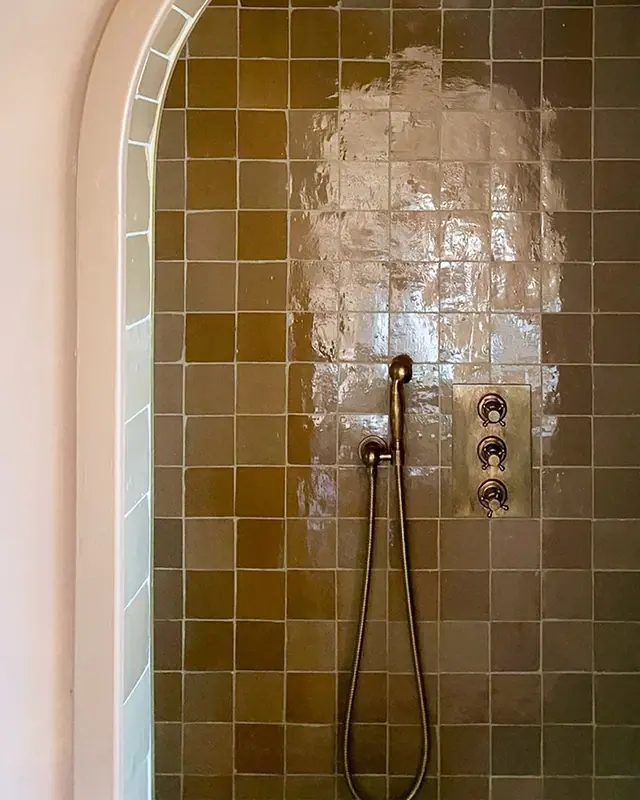
The wall carrying the shower set is where zellige performs best and where the steam actually shows its value: as the room heats, the glaze holds condensation in a way that makes the colour deepen and shift. It is the reason a green glaze in a shower looks like a different colour wet than dry, and it is entirely the point.
Take the tile to full height wherever the room allows. Stopping a wet wall at shoulder height and switching to paint creates a horizontal line exactly where the eye lands, and it puts a junction in the one place water reaches most often.
Niches and recesses
A recessed niche is the single most revealing detail in a tiled shower, because it puts internal and external corners within arm’s reach of someone standing still with nothing to do. It is worth resolving on a drawing: how the tile turns the corner, whether the return is a cut tile or a change of colour, and what happens at the top edge.
Two approaches read well. Either line the niche in the same glaze so it disappears into the wall, or line it in a contrasting colour so it reads as a deliberate object. The version that rarely works is a niche lined in the same colour but set out differently from the wall around it.
Benches, seats and ledges
Horizontal surfaces inside a wet area need a fall so water leaves them, and they need an edge detail that does not rely on a fragile arris. Where a bench is being tiled in zellige, the top is usually the place to introduce a different material – a stone or solid surface slab that gives a clean nose – with the zellige running up the face beneath it.
The shower floor
Small format tile follows a fall better than large format, which is a genuine argument for using zellige on a shower floor rather than a stylistic one. But the floor is also the surface that gets scrubbed, so the decision depends on the specific tile and glaze, and on how the space will be cleaned. This is worth resolving with your supplier against the actual product rather than as a general rule – the same conversation we set out in can zellige be used on floors.
The steam room or hammam proper
A true steam room is a harsher environment than a shower: continuous saturation, sustained heat, and a build-up that is designed as a sealed box. Here the tile selection is one line item inside a specialist package, and the steam contractor’s requirements govern. Bring them into the conversation early, share the actual tile with them, and let them confirm the build-up before the finish is locked.
What to agree before the tile is ordered
None of these are tile decisions, which is exactly why they get left too late.
- The waterproofing system, confirmed in writing. The tanking package, its warranty and its interface with the tile adhesive should all be resolved and compatible. This governs everything above it.
- Falls, set out on a drawing. Where water goes, at what gradient, to which drain, and how that interacts with the tile module.
- Movement joints. Where they occur, and how they will be detailed so they do not cut awkwardly through a panel of handmade tile.
- Corners, edges and stop details. Whether external corners are mitred, trimmed or turned with a cut tile. Handmade tile has a hand-cut edge, so the detail that works for a rectified porcelain will not simply transfer.
- Grout, colour and joint width. In a wet area this is a performance decision as well as a visual one. Our thinking on the visual half is in choosing grout colour for zellige.
- Care and cleaning at handover. Agree what housekeeping will use on the surface before the operator writes their own regime. Cleaning and maintaining zellige and bejmat covers what to hand over.
One thing worth insisting on
Ask for a sample panel of the actual tile, laid wet, before the full order is placed. Glaze behaves differently wet than dry, and in a shower the wet state is the normal state. A panel answers in thirty seconds what a flat sample board argues about for three weeks.
Choosing colour for a room full of steam
Wet areas are usually small, often windowless, and almost always lit artificially. That changes how a glaze behaves.
- Deep colours gain, pale colours flatten. A saturated green, teal or bronze picks up the reflection of a small room and gains depth. A very pale glaze in a windowless shower can read closer to grey than it did on the sample.
- Gloss multiplies whatever light there is. In a dark wet room, a glossy glaze is doing lighting work, not just decorative work.
- Warm light flatters warm glazes. Check the specified lamp colour temperature against the tile before committing. A cool white downlight over a terracotta pink will fight it.
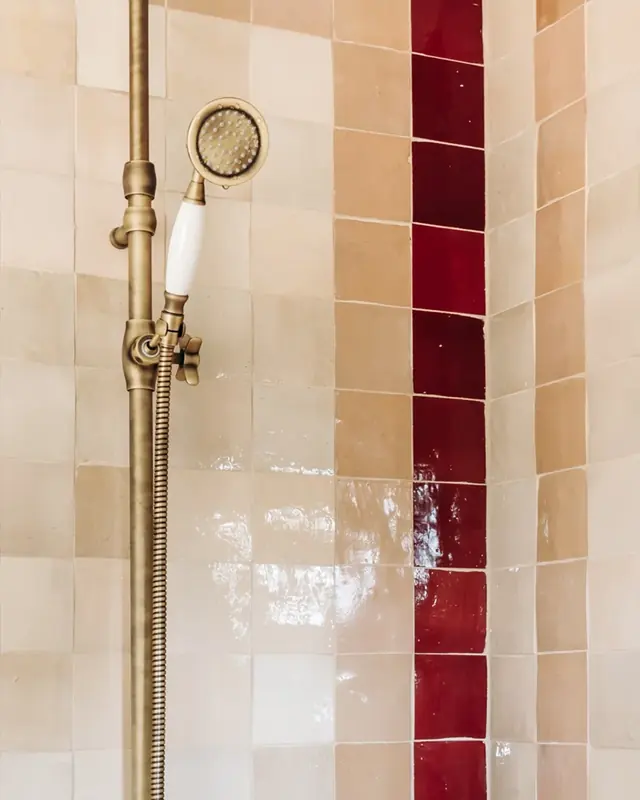
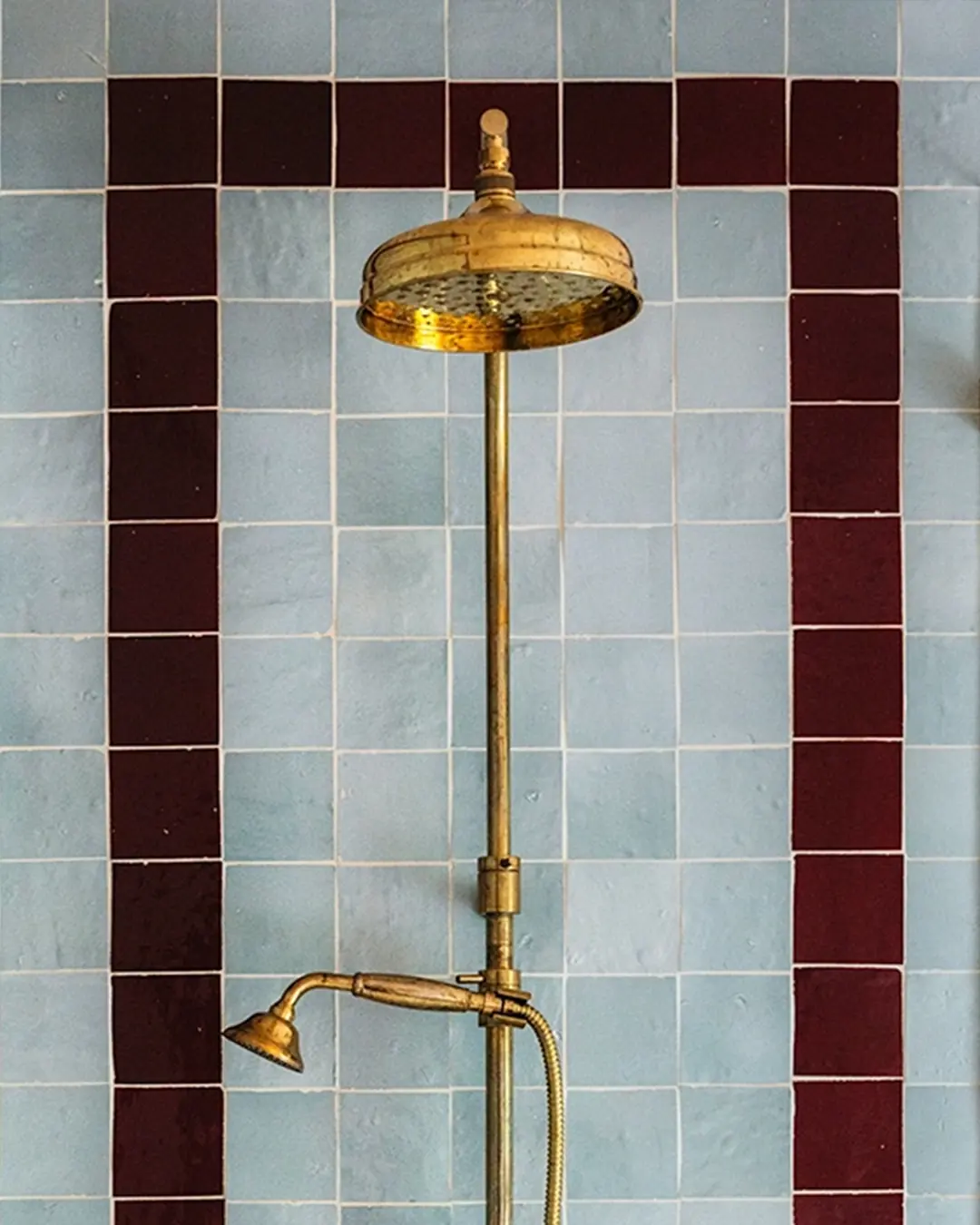
- One colour, fully wrapped, tends to beat three. Small rooms reward commitment. If you want a second colour, put it in a border or a niche rather than spreading it around.
Beyond that, trust the tradition. The rooms this material was made for were steam rooms, and the reason it is still made the same way is that nobody has found a surface that responds to heat, water and low light more beautifully.