
There is a version of a Moroccan interior that most designers are trying to avoid: everything at once, pattern on pattern, arches for the sake of arches, a room that announces a country. It is the reason a good specifier hesitates before putting zellige into a minimal scheme.
But the hesitation mistakes a quantity problem for a material problem. These are not decorative materials in origin. They are building materials – a tile that clads a wall, a terracotta that makes a floor, a pierced metal that shades a lamp, a wool that covers a ground. Used one at a time, at architectural scale, they do exactly what a minimal interior wants: they give a plain room something real to look at.
The principle: one material carries the room
Almost every restrained scheme that uses Moroccan craft well follows the same discipline. One material is given a large, uninterrupted area and allowed to be the only event in the room. Everything else recedes.
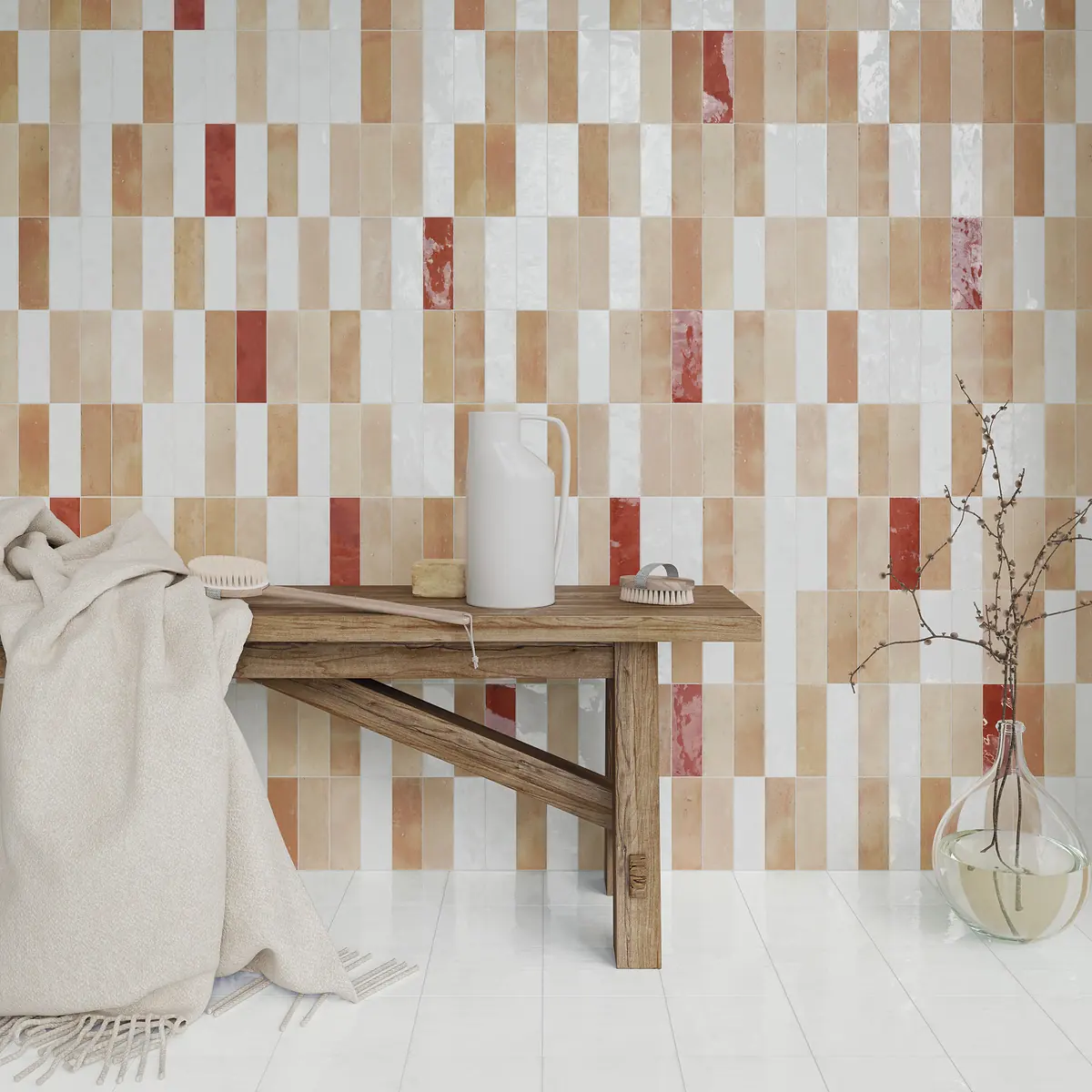
A full-height wall of a single zellige glaze behind an otherwise plain bathroom. A terracotta floor running through a white gallery of a dining room with nothing else on the walls. One large pierced brass fitting over a plain table, and no other decorative object in the space.
This is not a compromise. It is a stronger result than the alternative, because a material with this much internal variation needs room to be read. Crowd it with three other patterned things and none of them register properly – you get busyness, not richness.
Texture instead of ornament
The most useful shift is to stop thinking about these materials as decoration and start thinking about them as surface quality.
What a hand-glazed tile actually contributes to a minimal room is not a motif – it is a wall that is not flat. Light moves across it, the colour changes through the day, and the surface has depth at a distance and detail up close. That is the same thing a lime plaster, a board-marked concrete or a raw timber contributes, and minimal interiors have always depended on exactly that kind of material presence.
Read that way, none of these materials are stylistically committed at all. A sand-coloured zellige wall is simply a textured wall. A natural terracotta floor is simply a warm hard floor. Neither declares anything until you add the arch, the lantern and the carved screen alongside them.
Choosing which craft does the work
In a room that will take one gesture, the four crafts are not interchangeable. Each does something particular.
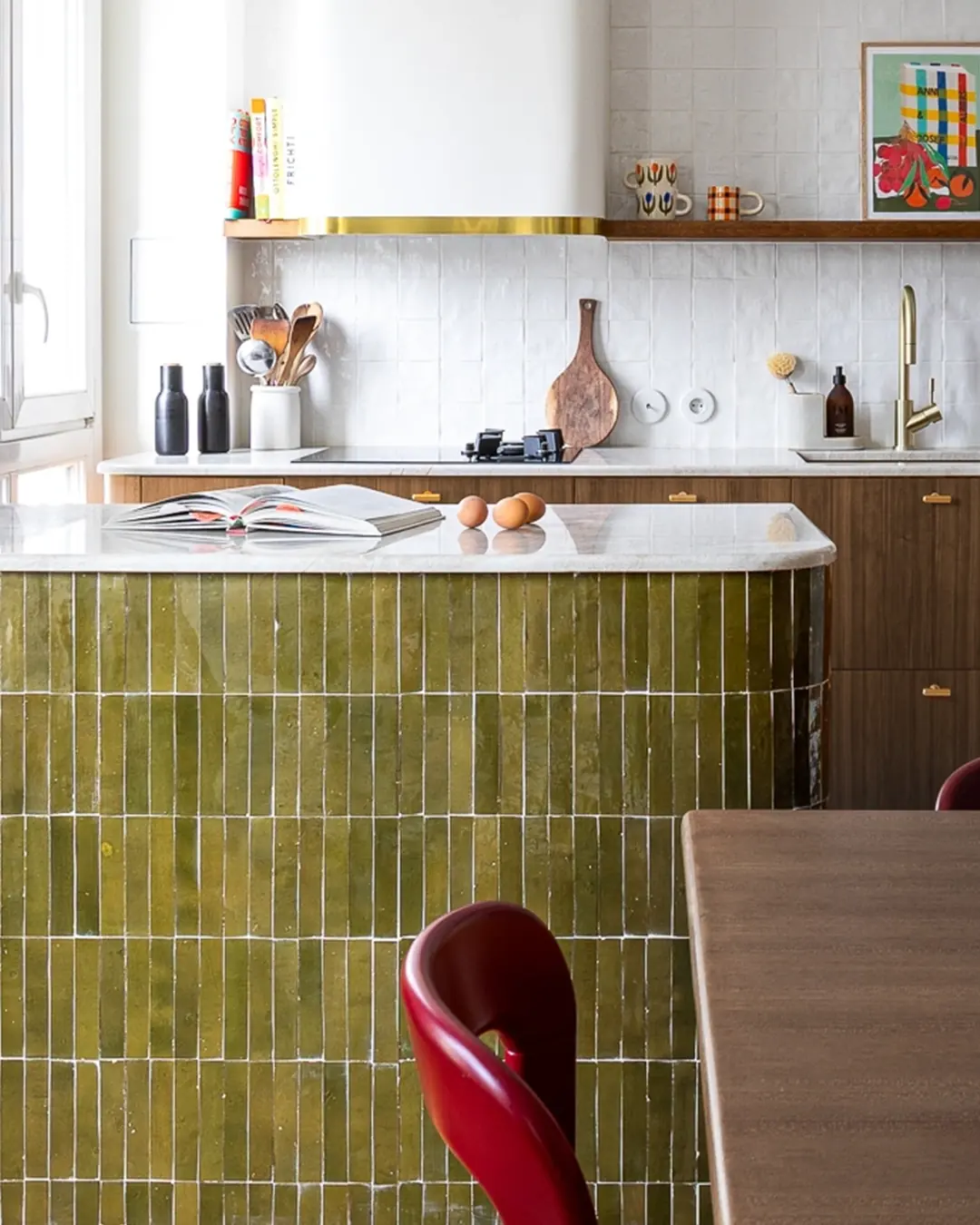
- Zellige gives you colour and light. The right choice when a plain room needs one thing to look at and the scheme can carry a colour. Keep to one glaze; let the tonal variation supply the interest. Palette guidance here.
- Bejmat gives you ground and warmth. The right choice when the walls must stay quiet. A terracotta floor warms an entire volume without occupying anything at eye level, which is why it suits minimal architecture so well.
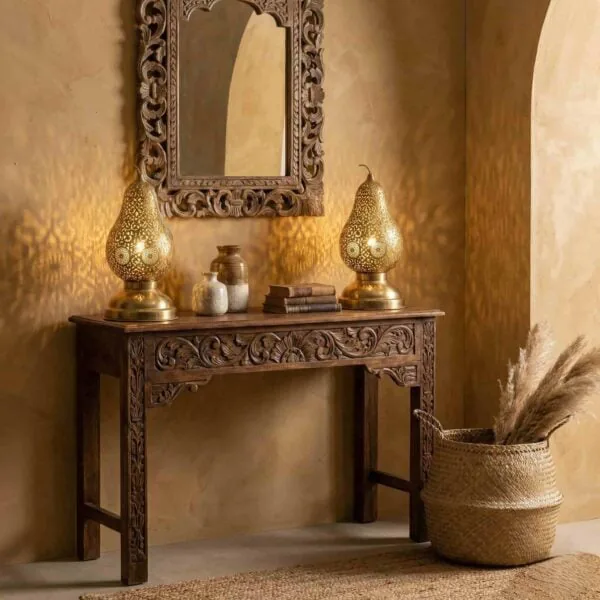
- Brass lighting gives you a single object. The right choice when the surfaces are already resolved and the room simply needs one thing with presence in it. Scale it properly – a small fitting in a bare room looks lost rather than restrained.
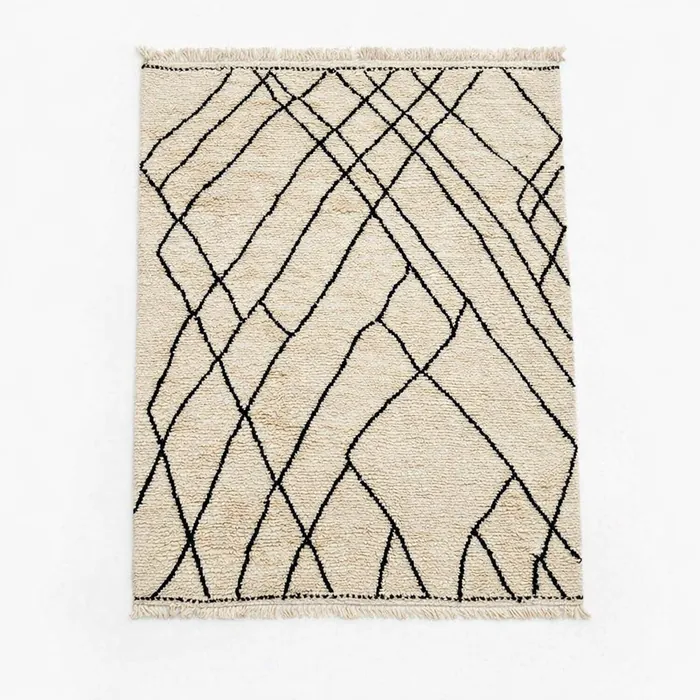
- Wool gives you softness and acoustic calm. The right choice in hard-surfaced rooms. Undyed Beni Ourain reads as texture rather than pattern, which makes it the most minimal-compatible of the four.
Restraint, in practice
Five habits that keep a craft-based scheme disciplined:
- Set a limit before you begin. One handmade material per room, or two at most where one of them is the floor. Decide it at concept stage and hold to it when the mood boards start expanding.
- Give the material a whole plane. A full wall, a whole floor, an entire recess. Fragments and panels read as decoration; complete surfaces read as architecture.
- Stay within one colour family. Warm neutrals with warm neutrals, or a single strong glaze against genuine neutrals. Two competing colour stories are what makes a room feel decorated.
- Avoid the signifiers. The craft can stay while the shorthand goes. A zellige wall without a horseshoe arch and a filigree screen is still unmistakably what it is, and far more contemporary for the omission.
- Let the joints and edges stay simple. Handmade material carries its own complexity. Meeting it with an elaborate detail doubles the information; meeting it with a plain reveal lets it speak.
The test for a scheme
Look at the render or the mood board and ask what a visitor would notice first, second and third. If the first three things are all handmade and all patterned, the room is carrying too much. If the first is a wall of one material and the second is the light falling on it, the balance is right.
Why the combination works at all
There is a reason minimal architecture and Moroccan craft have kept finding each other over the last two decades, and it is not fashion. Both are concerned with material honesty – with a surface being what it appears to be rather than a print of something else. A hand-cut tile and a poured concrete wall are arguing for the same thing from opposite ends of the ornamental scale.
What a minimal room lacks, left alone, is warmth and the evidence of a human hand. What Moroccan craft supplies, more reliably than almost anything, is exactly those two things. Used with any discipline at all, it does not fight a restrained scheme. It is what makes one habitable.
All four crafts – zellige, bejmat, lighting and rugs – are developed through our own workshops, which means a scheme can be resolved as one palette rather than assembled from four.