
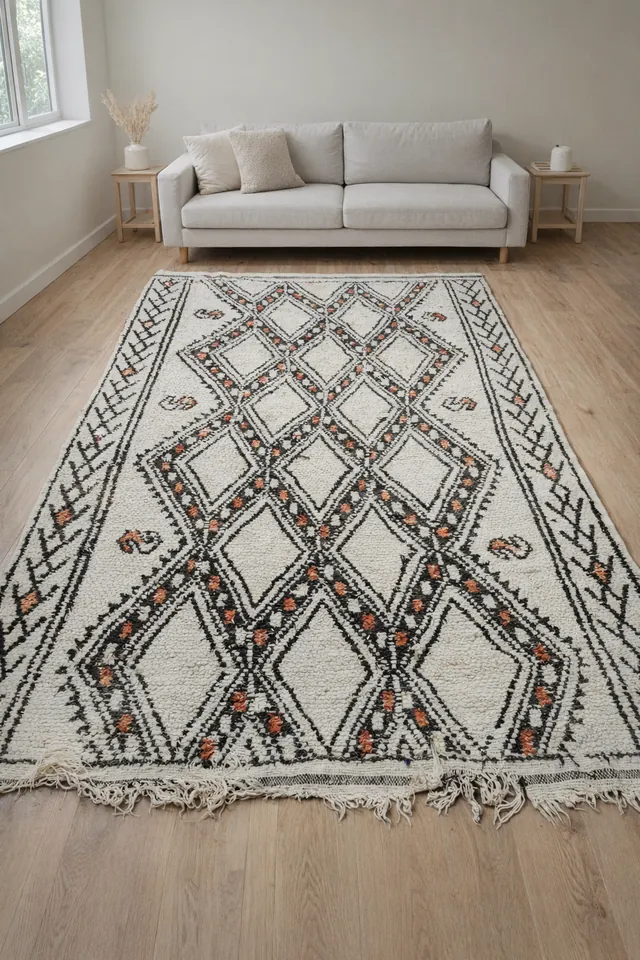
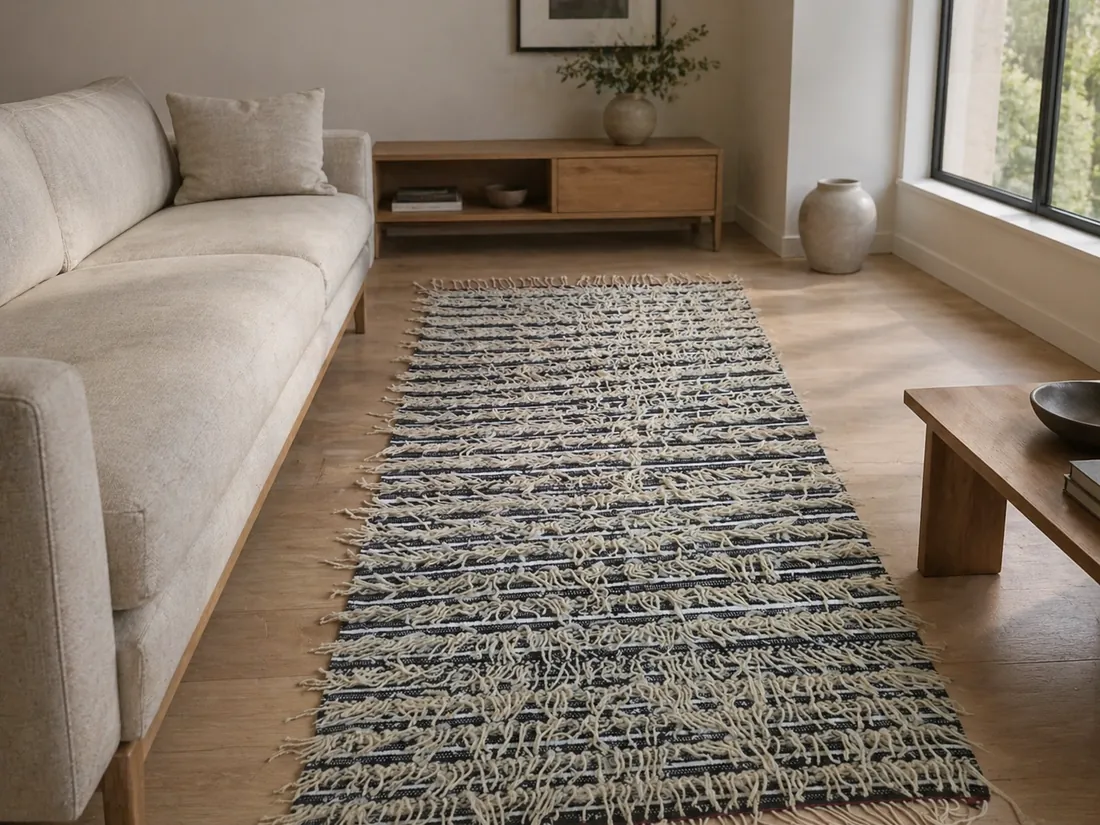
One difference, and everything follows from it
A Beni Ourain is knotted: individual tufts of wool are tied onto a warp and cut, so the surface stands up off the foundation as pile. A kilim is woven: the coloured wool is the structure, interlaced through the warp, so the rug is flat and has no pile at all.
That single structural difference produces every practical distinction between them – thickness, weight, acoustic behaviour, how each one handles traffic, what kind of pattern is possible, and how each sits under a door.
- Depth and softness The pile of a Beni Ourain is the whole point: warmth, softness, and a rug you want to be barefoot on. A kilim is thin and firm, pleasant but never plush.
- Acoustics Pile absorbs sound; flatweave does relatively little. In a hard-surfaced room with stone or terracotta floors, this is often the deciding factor.
- Pattern language Knotting allows soft, slightly blurred lines – the loose diamond lattices and hand-drawn symbols of the Atlas. Flatweaving favours straight lines, bands and stepped geometry, so kilim patterns are sharper and more graphic.
- Colour Beni Ourain traditionally works in undyed wool – ivory, cream, charcoal and natural browns. Kilim has always carried colour, and carries it in blocks and bands.
- Under doors and furniture A flatweave slides under a door swing and sits flat beneath furniture legs. A deep pile rug needs the door undercut checked, and will hold furniture impressions.
- Handling traffic Flatweave has no pile to crush, so it holds its appearance in a circulation route. Pile in a doorway or a corridor flattens along the walked line.
Which room wants which
Bedrooms and suites – Beni Ourain
The clearest case. Bare feet, low traffic, and a room where softness and sound absorption both matter. A pile rug under a bed, running past the sides and the foot, is what a guest actually notices in a hotel suite.
Living rooms and lounges – either, depending on the scheme
If the room is hard-surfaced, echoing, or intended to feel enveloping, choose pile. If the floor is already the feature – a bejmat herringbone you do not want to bury – a flatweave lets the floor read through and adds pattern without mass.
Entrances, corridors and circulation – kilim
Flatweave is the practical answer wherever people walk in a line. It stays flat, it does not crush, it is easier to lift and clean, and a runner in a corridor is one of the most useful things a kilim does.
Dining rooms – kilim, usually
Chairs pull in and out across the rug surface. A flatweave takes that better than a pile, and it is less inclined to trap what falls off a table.
Reception and lobby – depends on the role
To warm a hard space and define a seating group, pile. To mark a zone in a busy circulation area without creating a threshold, flatweave. Both benefit from being sized properly – see rug sizing for hotel suites, lobbies and lounges.
The case for using both
In a project of any size, the question is rarely either/or. The two weaves do different jobs and they look well together because they share a material and a vocabulary – the same wool, the same geometric family, the same hands.
A workable distribution across a hotel: pile in the guest suites where softness is felt; flatweave in the corridors, the entrance and the restaurant where traffic is constant; and a decision per space in the public lounges depending on whether that room needs quieting or defining.
What holds it together is restraint in the palette. Undyed Beni Ourain and a kilim in two or three colours will always sit well; five different patterned rugs in five different colourways will not, however good each one is on its own.
A third option worth knowing
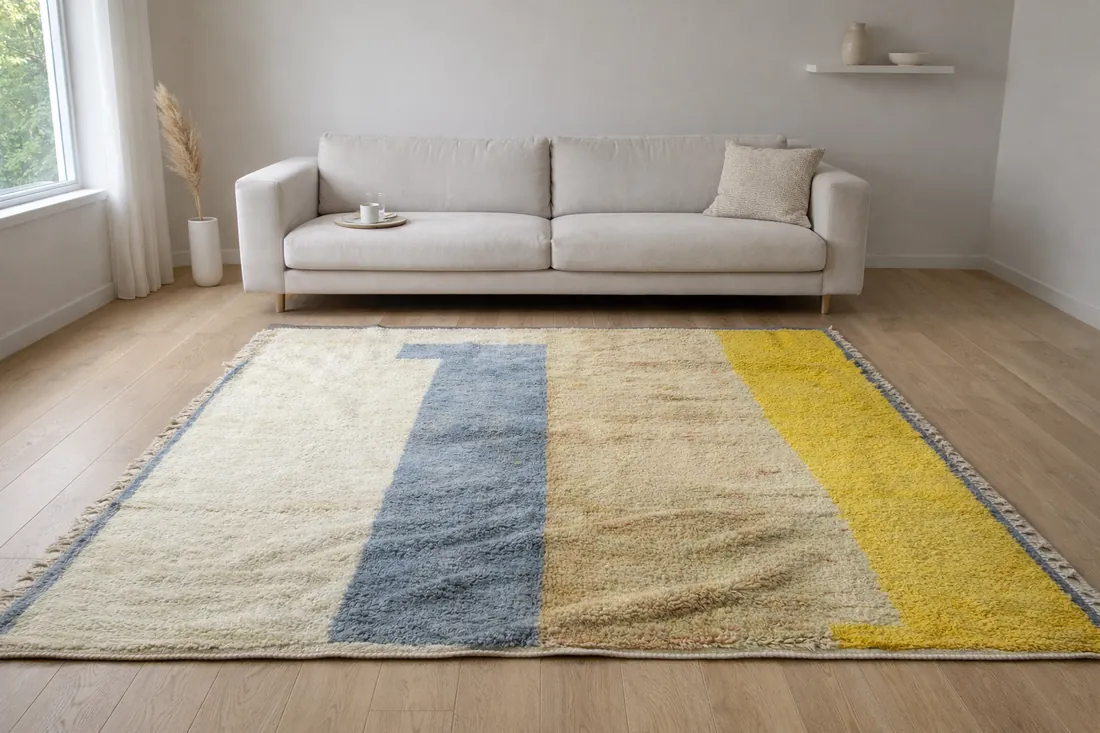
Custom-dyed pile rugs sit between the two – the depth and softness of a knotted rug with the colour and graphic confidence usually associated with flatweave. If a scheme wants a strong colour underfoot in a bedroom, that is the direction to look. Our rug collection includes both traditional undyed Beni Ourain and custom-dyed pieces.
Two practical notes
Underlay matters more than people expect. Both weaves benefit from a proper rug pad: it stops movement, protects the foundation of the rug from grinding against a hard floor, and in the case of a flatweave it adds the small amount of cushioning the rug itself does not have.
Size is a bigger decision than weave. A well-sized kilim will look better in a room than an undersized Beni Ourain, every time. Resolve the dimensions against the furniture layout before you resolve the construction – it is the mistake we see most often in FF&E packages.