
Bejmat is the Moroccan floor tile. Not a wall tile pressed into service on the horizontal, not a decorative tile with a floor rating added later – a thick, kiln-fired terracotta that has been laid in courtyards, riads, kitchens and public rooms for centuries, in buildings that are still being walked through today.
That history is the real answer to the durability question, and it is more persuasive than any number in a brochure. But an operator specifying a restaurant in 2026 needs more than a tradition, so it is worth setting out what a commercial floor is actually being asked to do and where this material sits against it.
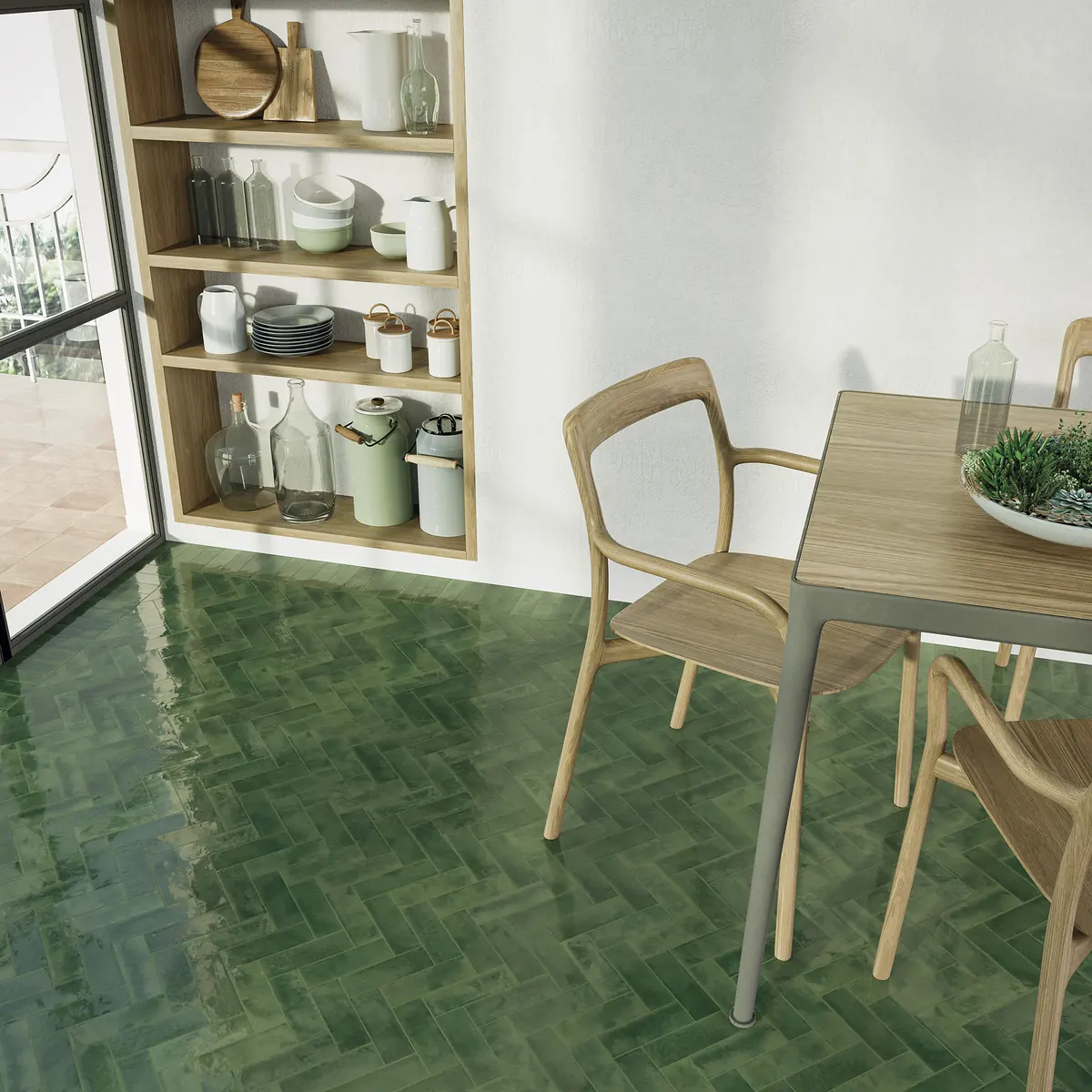
What a restaurant floor is actually asked to do
Strip away the specification language and the demands come down to five things:
- Take chairs. Not foot traffic – chairs. A dining chair is dragged, pivoted and dropped onto the floor hundreds of times a service, always in the same places.
- Take spillage. Wine, oil, sauce, coffee, and whatever the cleaning contract uses to remove them.
- Take a cleaning regime. Usually a wet regime, daily, with machinery in larger spaces.
- Stay safe when wet. A separate question that belongs with the project’s own assessment rather than a general claim.
- Look better in year five than year one. The one nobody writes into the specification and every operator cares about.
The first four are performance questions and they are answered against a specific tile, a specific substrate and a specific regime – not against a material in the abstract. The fifth is where handmade terracotta has an advantage that no engineered product can match, and it is worth spending a moment on.
The patina argument
Every hard floor changes with use. The difference is the direction of travel.
A printed or engineered floor is at its best on the day it is handed over. Every subsequent year subtracts from it – the pattern wears through at the door, the sheen goes flat in the traffic lanes, and the difference between the worn areas and the protected ones reads as damage because the original was uniform.
Natural terracotta starts from a different premise. It was never uniform, so the wear does not register as deviation. What accumulates instead is patina: a deepening in the circulation routes, a slight polish where people turn, a floor that gradually describes how the room is used. In a restaurant trying to feel established rather than newly fitted out, that is not a defect to be managed. It is the single hardest quality to buy.
How to put this to an operator
Frame it as a choice between two kinds of ageing rather than between durable and delicate. One floor looks new and then looks worn. The other looks made and then looks lived in. Ask which one suits the room they are trying to open.
Where bejmat suits a restaurant particularly well
- Dining rooms with a warm, material identity. Anywhere the design narrative uses the words texture, craft or provenance, and needs the floor to support it rather than contradict it.
- Courtyards and indoor–outdoor rooms. The material reads as continuous from an interior into a terrace, which very few floor finishes manage convincingly.
- All-day venues. A floor that photographs well at breakfast and at midnight, because it has colour and depth rather than a flat tone.
- Spaces where acoustics matter. A hard floor is a hard floor, but a textured one with a visible joint pattern breaks up reflections more than a large-format, tightly-jointed surface.
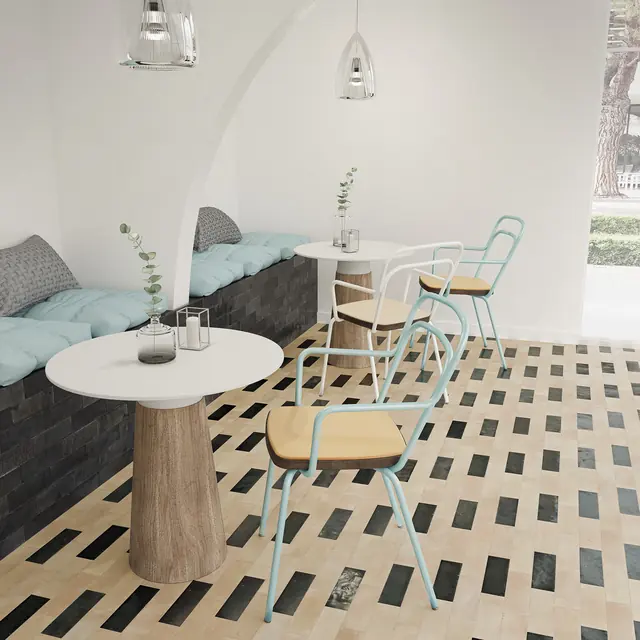
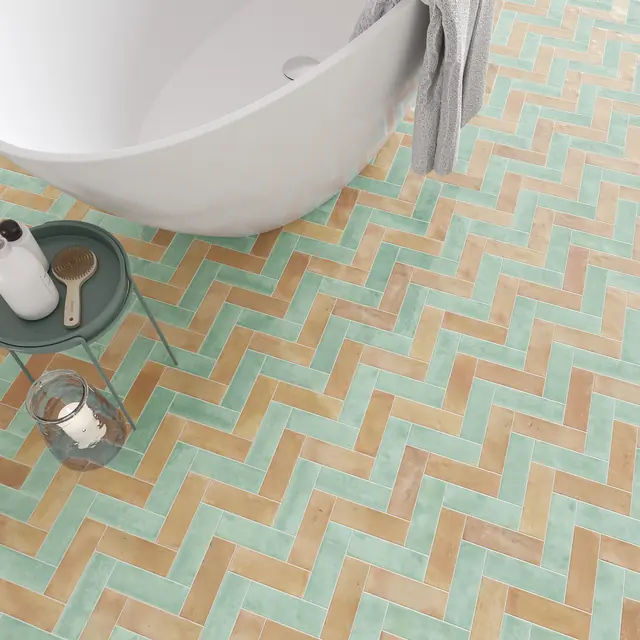
What to settle before you specify it
None of this is exotic – it is the same diligence any commercial floor deserves. It is simply worth doing before the finish is approved rather than after.
- Confirm performance against the actual tile. Finish, body and treatment all vary between workshops and between glazed and natural product. Ask your supplier for guidance on the specific tile you are specifying, and get it in writing for the file.
- Agree the cleaning regime with the operator, in advance. This is the most common cause of trouble with any natural floor, and it is entirely preventable. See cleaning and maintaining zellige and bejmat.
- Resolve the substrate and movement joints. A handmade tile is only as stable as what it is fixed to, and a commercial floor moves more than a domestic one.
- Plan the layout for the traffic. Circulation routes, service doors and the strip in front of the pass all take more than the seating zones. Layout choices can reinforce those routes or ignore them.
- Hold attic stock. Handmade tile is matched within a production run rather than across time, so keep spare material from the original order for future repairs. The reasoning is in why colour varies between batches.
- Protect it during the rest of the fit-out. Most damage to a new floor happens between laying and opening, not after.
Where we would steer you elsewhere
Back-of-house kitchens are a different specification entirely, governed by hygiene and drainage requirements that a decorative floor should not be asked to satisfy. Heavy goods routes, loading areas and anywhere with wheeled equipment running continuously over the same line are also better served by something engineered for it. And if the operator’s cleaning contract cannot be influenced at all, that is worth knowing before the floor is chosen rather than after.
Everywhere else – the dining room, the bar, the courtyard, the entrance – this is a material that has been doing exactly this job for a very long time.