
“Authentic Beni Ourain” bundles three separate claims, and it is worth separating them before inspecting anything, because a rug can satisfy one and fail the others.
- Handwoven rather than machine-made. The most important distinction commercially, and the easiest to verify by looking.
- Woven in Morocco, in the tradition. A question of provenance, which cannot be settled by inspection alone – only by the supply chain.
- Woven by the Beni Ourain tribes of the Middle Atlas. The strictest reading, and the one most loosely used across the market.
For a specifier, the first two are what matter. The third is a question of how precisely a supplier describes what they sell, and the honest answer from most of the trade is that “Beni Ourain” has become a description of a style of Moroccan pile rug – undyed wool, geometric lattice, long pile – as much as a strict tribal attribution.
What to examine, in order
Turn it over first
The back tells you almost everything. A hand-knotted rug shows the pattern from behind, formed by the knots themselves, with rows that are not perfectly even and a slight wander to the lines. A machine-made rug typically has a backing – a grid, a latex layer or a stitched cloth – and the reverse either does not show the pattern properly or shows it with mechanical regularity.
Look at the edges and the ends
A handwoven rug is finished by hand: the sides are wrapped, the ends carry the warp threads as a fringe, and the fringe is part of the rug’s structure rather than something attached to it. A sewn-on fringe is a strong signal of machine production.
Check whether the rug is truly rectangular
It almost certainly is not, and that is a good sign. A rug woven on a traditional loom will be slightly wider at one end, a little off-square, with edges that are not dead straight. Perfect geometry indicates a machine.
Read the pattern for hand-drawing
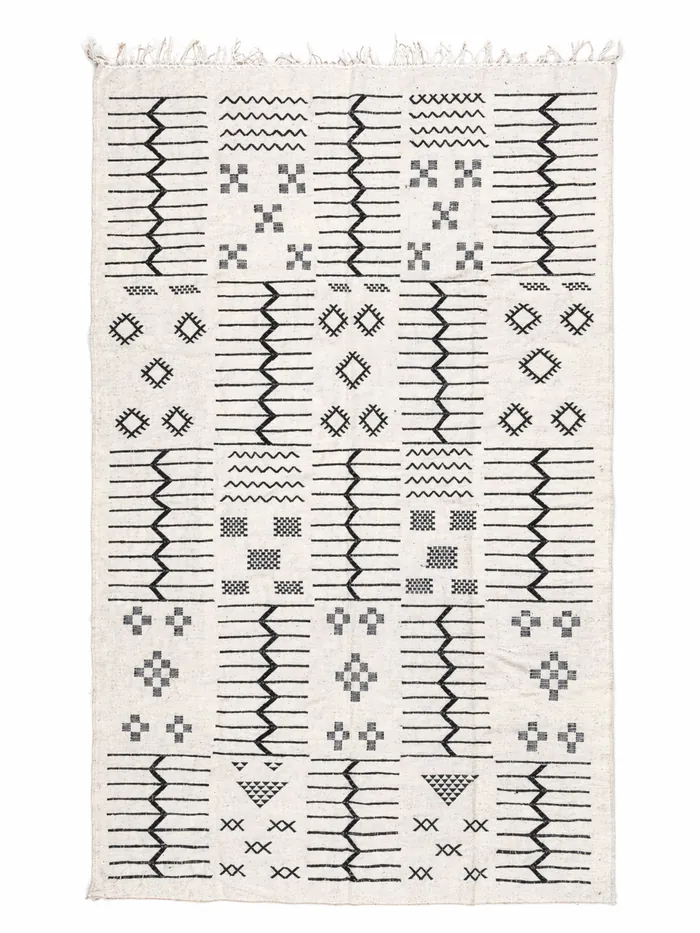
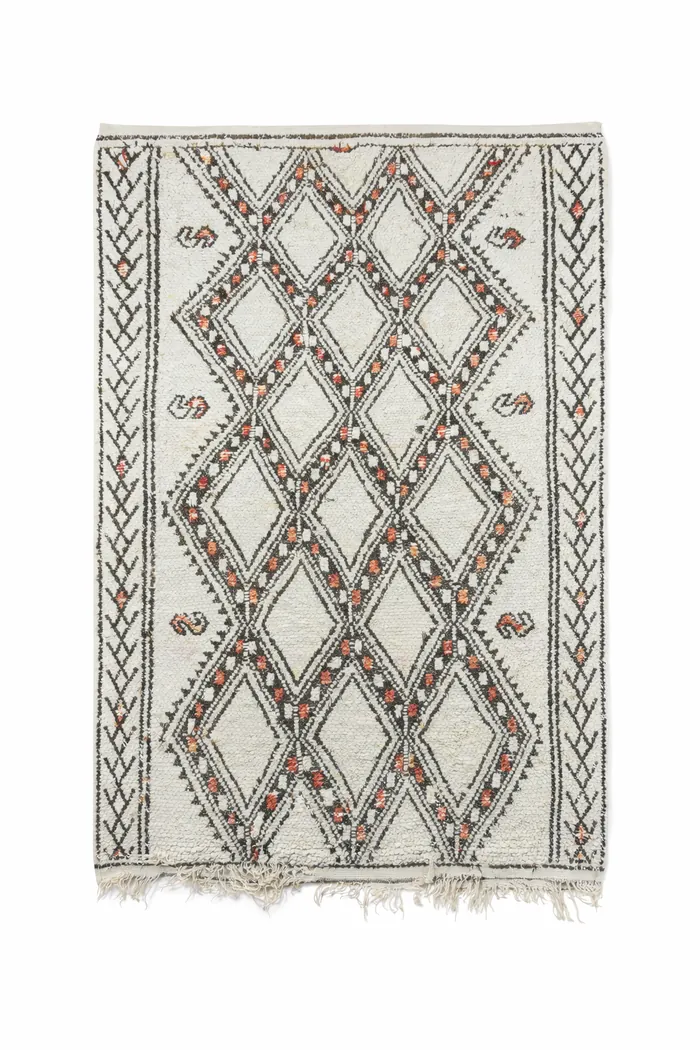
In a handwoven lattice the diamonds vary: slightly different sizes, lines that drift, a motif that changes as the weaver worked up the rug. The pattern was carried in memory, not from a file. Look for the moments where the weaver improvised – a symbol inserted into a field, a band that changes rhythm. Machine rugs repeat exactly, and the repeat length is findable.
Handle the wool
Hand-spun wool is uneven along its length, so the pile has a variable, slightly rustic texture rather than a uniform one. Undyed Beni Ourain wool is rarely a single flat ivory – it carries the natural range of the fleece, which is why these rugs sit so easily against warm interiors.
The tests that do not deserve their reputation
Three circulate constantly and none of them should decide a purchase.
The burn test. Cutting a fibre from a rug and setting fire to it tells you whether the fibre is wool or synthetic. It tells you nothing about whether the rug was made by hand, in Morocco, or in the tradition – and a handwoven rug can be made from poor wool while a machine rug can be made from good wool. It is also destructive, which is difficult to justify on a piece you are considering buying.
The smell test. Wool has a scent. So does wool that has been washed, stored, shipped, or treated. A rug that smells of nothing may simply have been cleaned properly.
The price test. “If it is cheap it is fake” is not a test, it is a proxy, and it fails in both directions. Judge the rug, then judge the supplier.
What to ask a supplier
Inspection tells you how a rug was made. Only the supply chain tells you where and by whom, so the questions matter more than the examination.
- Where was this woven, and by whom? A supplier working directly with weavers can answer specifically. A supplier several steps removed will answer in categories.
- Is the wool hand-spun? A separate question from whether the rug is hand-knotted, and one that shows in the pile.
- Is it undyed, or dyed to look undyed? Both exist and both are legitimate. It should simply be stated.
- Can this be woven again to our dimensions? The most revealing question of all for a project. A supplier with a real weaving relationship can commission a size; a supplier buying finished stock cannot.
- What happens if the piece is damaged on site? Repair and reweaving are normal in this trade when the relationship reaches the loom.
For projects, this matters more than authentication
On a single rug for a private client, authenticity is the question. On a hotel with forty suites, the question is whether the pieces can be produced consistently, sized to the rooms and repeated later – which only a direct weaving relationship supports. We work with our own weavers, which is why our rug collection can be made to project dimensions rather than sold as found.
A note on variation between pieces
If you order several handwoven rugs in the same design, they will not be identical. The lattice will sit slightly differently, the wool will carry slightly different tones, and the dimensions will vary a little. This is the same principle at work in a handmade tile, and it needs the same treatment: agree it explicitly, specify against an approved sample, and if pieces are going into rooms that guests will compare, have them woven together.
Authenticity, in the end, is less a property of an object than of a relationship. A rug that can be traced to the people who made it, described accurately, and woven again to a different size is authentic in the way that actually helps a project. Everything in the inspection list above is simply a way of checking that the description you have been given is true.