
Put simply: zellige is a wall tile that can occasionally go down, and bejmat is a floor tile that can very happily go up. Almost everything else follows from that.
They are close relatives. Both are natural clay, worked by hand in Fès, dried, fired and finished in workshops that in many cases make both. What separates them is what each was developed to survive.
Zellige is made to be looked at. It is cut small, glazed by hand and finished so that the surface catches light – every decision in its production serves appearance. Bejmat is made to be walked on. It is thicker, denser, longer in proportion, and fired to be a floor; its character comes from the clay body and the way the tiles sit together rather than from a glaze. Neither is a refined version of the other. They are two answers to two different questions, developed side by side in the same city.
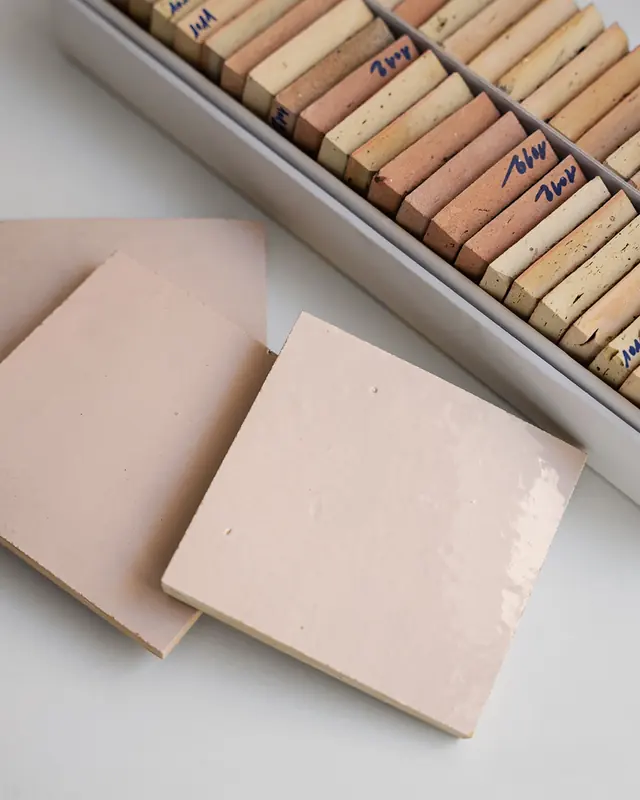
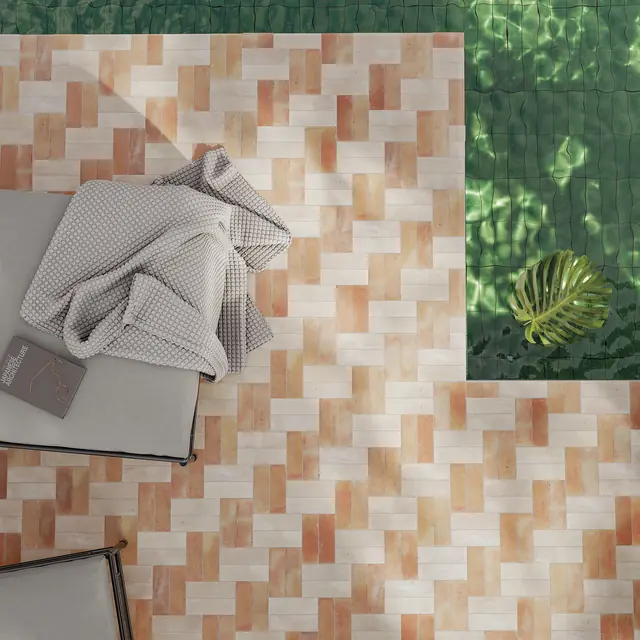
The comparison in one view
| Zellige | Bejmat | |
|---|---|---|
| Developed as | A wall and feature surface | A floor surface |
| Format | Square and cut shapes, small module | Elongated, brick-like proportion |
| Finish | Hand-glazed, luminous, reflective | Natural terracotta or glazed |
| What the eye reads | Colour that moves with the light | Pattern, rhythm and laying direction |
| Best on | Feature walls, splashbacks, bar fronts, wet walls, risers, niches | Floors, terraces, courtyards, stairs, and walls where you want texture over gloss |
| Layout does | Little – the glaze carries the surface | A great deal – herringbone, stack and basketweave each change the room |
| Ages by | Holding its glaze, gaining patina at the edges | Developing a worn patina underfoot, which is part of the appeal |
Working through a project
Hotel lobby
Bejmat on the floor, where the traffic is. Zellige on a reception desk face, a lift lobby panel or a column, where guests stand close and wait. The two do not compete because they occupy different planes.
Restaurant or café
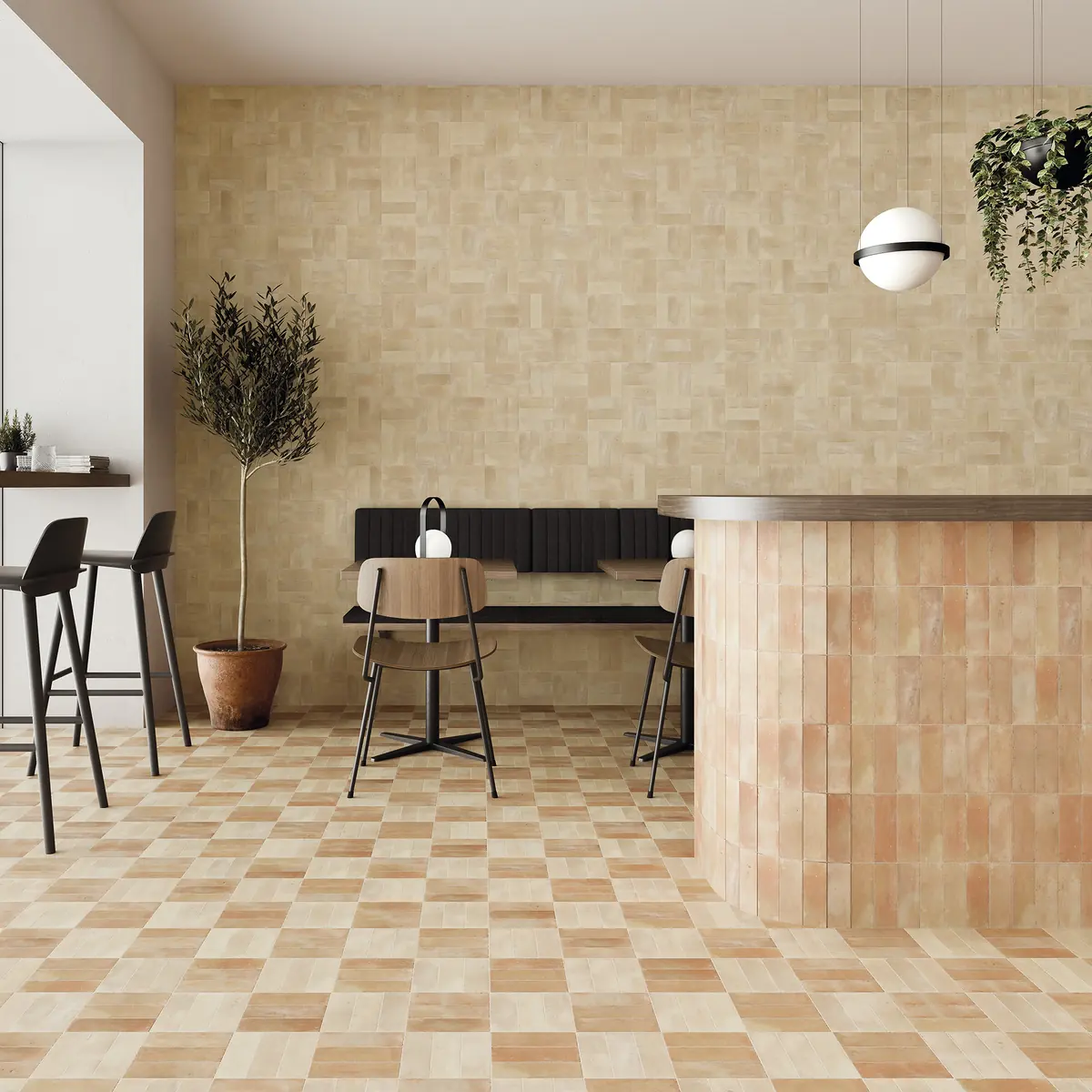
The floor is a bejmat question – and a serious one, covered in is bejmat right for restaurant floors. The wall behind a banquette or the front of a bar is where zellige earns its keep, because it is lit, looked at and photographed.
Guest bathroom or spa
Zellige on the wet walls, almost always. The floor depends on the room: bejmat for a larger bathroom that reads as a space, zellige for a small enclosed shower floor where the fall needs a small module. The wet-area guide works through it zone by zone.
Kitchen
Splashback and island face in zellige; floor in bejmat if the kitchen is front of house, something more utilitarian if it is not.
Retail and showroom
A bejmat floor takes the traffic and the display fittings; a zellige counter face or a panel behind the till gives the space a single point of colour that photographs well, concentrated into a small enough area to stay manageable within a fit-out.
Terrace, courtyard and pool surround
Bejmat, with zellige reserved for vertical accents – a fountain, a bench face, a threshold band. Outdoors has its own constraints, especially in the Gulf, and we cover those in Moroccan tile outdoors in Gulf climates.
When bejmat is the better wall
This is the case that gets overlooked. Zellige is the default answer for a Moroccan wall, but bejmat on a wall does something different and sometimes more appropriate:
- When the scheme wants matt, not gloss. Natural bejmat has no reflective glaze, so it reads as a solid material rather than a light-catching one.
- When you want a visible direction. Stacked vertically it lifts a low room; laid horizontally it stretches a narrow one. The format does the work.
- When a wall meets a floor of the same tile. Running bejmat up from the floor into a bench, a plinth or a low wall creates a continuous mass that reads as architecture rather than finish.
- When the budget concentrates elsewhere. Using bejmat across a large background wall and saving the zellige for one concentrated panel is a sound way to spend a tile budget.
If you only take one rule
Specify by plane, not by preference. Horizontal surfaces that carry traffic get bejmat. Vertical surfaces within arm’s reach get zellige. Everything in between – risers, benches, thresholds, low walls – is a judgement call, and either tile can be made to work if it is drawn properly.
Using both without the scheme fragmenting
The risk of specifying two handmade surfaces is that a room starts to look like a materials library. Three things keep it coherent.
- Share a colour, not a finish. A sand bejmat floor under a deeper glazed zellige wall in the same family reads as one idea. Two unrelated colours read as two decisions.
- Give each one a plane and keep it there. Do not let the floor tile climb the wall in one room and the wall tile drop to the floor in the next.
- Let one dominate. Decide which material the room is about. The other supports it.
Both ranges – zellige and bejmat – are made in our own workshops, in custom colours where a project needs one, which means a bejmat floor and a zellige wall can be developed against each other rather than chosen from two separate catalogues.