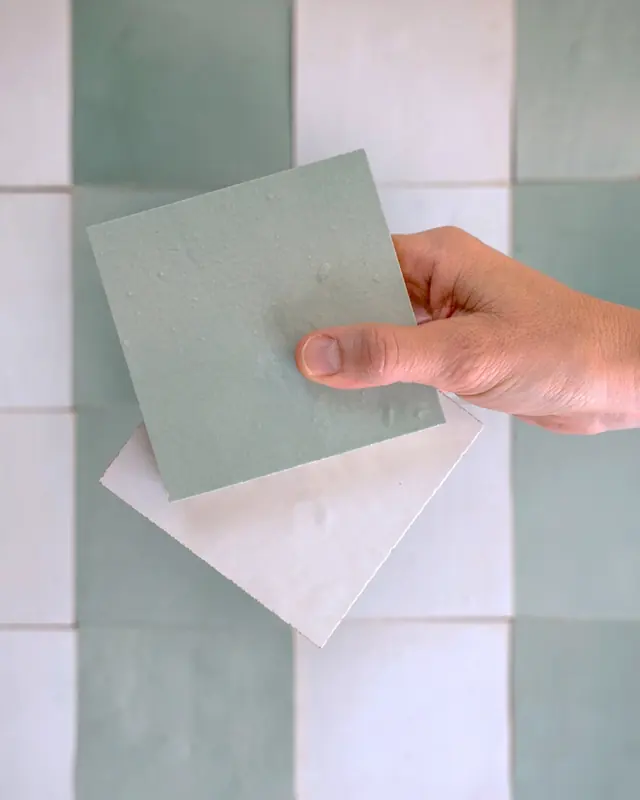
A designer in Dubai specifies a Moroccan scheme: zellige in the spa, a terracotta floor through the restaurant, pierced brass in the corridors, handwoven wool in the suites. Four crafts, all handmade, all originating within a few hours of each other in Morocco.
What frequently happens next is that those four items are bought from four unrelated sources, none of whom made anything, each of whom is buying from workshops they do not control. The colours do not relate, the quality varies, nobody can commit to a repeat, and every question takes a week because it has to travel down a chain and back.
That is the problem worth solving, and it is a structural one rather than a supplier-quality one.
What “direct” actually changes
The distinction that matters is not how well a supplier communicates. It is whether the relationship reaches the kiln, the bench and the loom.
- Custom becomes possible. A glaze can be developed toward your reference, a fitting can be pierced at a different scale, a rug can be woven to your room dimension. None of that exists when someone is selling finished stock.
- Production can be planned as one run. Handmade material is consistent within a production run rather than across time, so the ability to schedule the whole scheme together is a quality control mechanism, not a convenience. The reasoning is in why zellige colour varies between batches.
- Questions get answered from the workshop. Whether a shape can be cut, whether a colour can be pushed warmer, whether a pattern can be adapted – these are answered by the people doing it, in hours rather than weeks.
- Repeats are possible. Phased projects, replacements and future refurbishments depend on someone still being able to reach the maker.
- Provenance can be stated. Increasingly a requirement rather than a nicety, particularly where a project makes claims about craft in its own marketing.
How it runs, stage by stage
Why coordinating across crafts matters
A Moroccan scheme is rarely one material – zellige, bejmat, lighting and rugs frequently appear in the same drawing set. When the tile, the lighting and the rugs come from unrelated sources, three things go wrong quietly: the metals do not agree, the warm tones sit slightly apart, and nobody is responsible for the relationship between them – each supplier has delivered exactly what was ordered.
Developed together, the opposite happens. A glaze can be pushed toward the tone of a rug. A brass finish can be adjusted to sit beside a particular tile rather than fight it. The scheme reads as one intention, which is usually what the design narrative claimed in the first place.
Where the GCC project has an advantage
Morocco and the Gulf are close enough for material to move sensibly and for a working relationship to stay responsive. Our own arrangement reflects this: the workshops are in Fès, with a coordination base in Dubai, so a project team has someone in a compatible time zone while production stays where the craft is.
Questions worth asking any supplier
These separate a workshop relationship from a trading one faster than anything on a website:
- Who makes this, and where? A direct relationship answers specifically. Vagueness here is the answer.
- Can this colour be developed toward our reference? And how will it be proved – by a fired sample, or by a photograph?
- Can the whole scheme be produced in one run? The single most useful quality-control question for handmade material.
- Can we order this again in two years? Relevant to every phased project and every operator.
- What do we get at handover? Attic stock, care guidance written against the actual products, and a record of what was approved.
- Who resolves a problem on site? And how many steps away from the workshop are they?
Two things to plan for
Sampling takes real time, and it is time well spent. Handmade material has to be proved physically, and colour has to be proved by firing. Build a proper sampling period into the programme rather than compressing it – almost every difficult conversation later traces back to a sample stage that was rushed.
Quantities should be settled once. Because material is matched within a run, the whole area plus its spares should be produced together. Work out the areas properly, agree the allowance with your supplier against the actual drawings, and resist the instinct to order the minimum and add later.
Everything else is ordinary project discipline. What makes handmade sourcing feel difficult is usually the distance between the specifier and the maker – close that, and it behaves much like any other well-run package.
Can Moroccan craft be supplied for a large hotel project?
Yes, provided the production is planned rather than bought piecemeal. The workshop model scales through planning – agreeing the scheme, sampling properly and producing related areas together – rather than through holding stock.
Is it better to source each craft separately?
Rarely. Separate sourcing puts the relationships between materials – the metals, the warm tones, the level of finish – outside anyone’s responsibility. Coordinating them through one workshop relationship is what lets a glaze, a brass finish and a weave be developed against each other.
What should we have ready before making contact?
The spaces and their uses, the design direction or moodboard, an indication of quantities by area, and the programme. Precise specifications are not needed at that point – the material direction matters more than the detail this early.