
Lighting

Moroccan lighting in
hospitality interiors

A hand-pierced brass fitting is two things at once: a light source and a pattern generator. Design for only the first and you waste half of what you have specified.

Guide Lighting 7 min read

Most decorative fittings do their work in daylight, as objects, and then simply glow after dark. A pierced or engraved brass fitting works the other way round: it is handsome unlit, and when it is switched on it throws the pattern of its own perforation across the ceiling, the walls and the floor. The room gains a second layer of decoration that did not exist a moment before.

That is the property to design around. Everything below – scale, clustering, placement, lamp choice – is about making sure the shadow has somewhere to land.
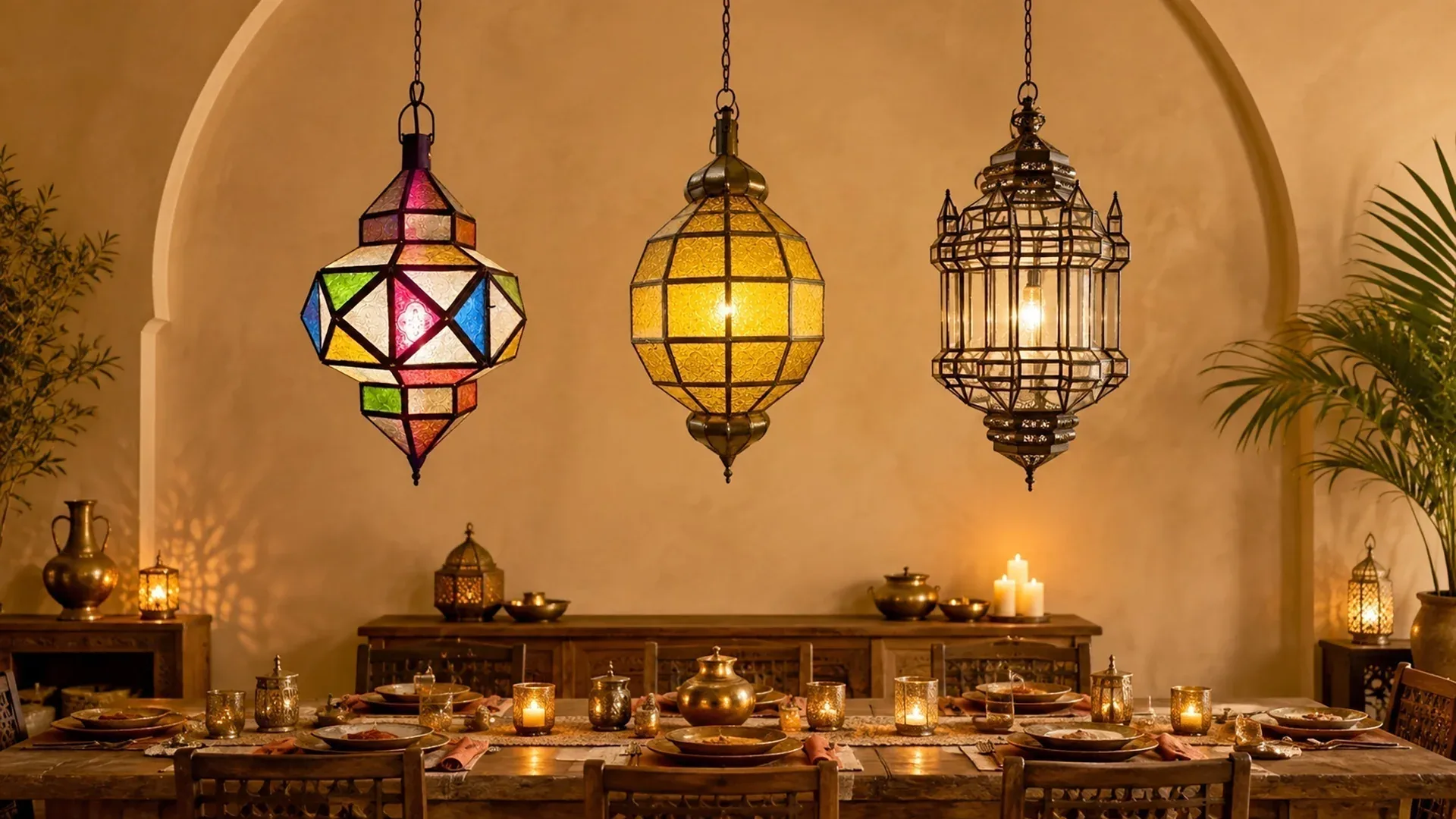
Three hand-pierced brass pendants hanging in a row above a dining table
A trio over a table. Repetition at a controlled spacing reads as one gesture; the same three fittings scattered would read as three decisions.

Scale: bigger than feels comfortable on the drawing

The most common failure in hospitality lighting is under-scaling, and it happens because fittings are chosen on a screen where every product fills the frame identically.

Two things govern the answer. The first is ceiling height – a double-height lobby will swallow a fitting that would dominate a guest room. The second, and more often overlooked, is the size of what the fitting sits above or beside: a pendant relates to the table beneath it, a sconce to the panel of wall it occupies, a floor lamp to the chair it stands next to.

A reliable habit: print the fitting at scale on the elevation before approving it. Not on a mood board – on the elevation, next to the door height and the furniture. Under-scaled lighting is almost impossible to rescue later, because the fix is a different fitting.

In public spaces there is also a case for deliberate over-scaling. A single large pierced fitting in a lobby becomes an architectural event, and it does considerably more for a space than three medium ones distributed politely.

Clustering: repetition beats arrangement

Moroccan fittings cluster well, and they cluster best when the logic is obvious.

  • In a line, at even spacing. Over a long table, a bar, a reception desk or a run of counter. The most disciplined option and the hardest to get wrong.
  • In a tight group at varied heights. Over a stairwell, a void or a round table, where the group reads as a single sculptural mass. Vary the drop, not the fitting – three identical pieces at three heights read as intentional, three different pieces at three heights read as indecision.
  • In pairs, flanking. Two sconces either side of a mirror, a bed, a doorway or an arch. The oldest arrangement in the vocabulary and still the most reliable.
  • Alone, with space around it. Where the fitting is genuinely a statement piece, give it clearance. Crowding a large fitting with downlights kills the shadow it was specified to cast.

Whichever pattern, hold the spacing constant and centre it on something real – a table, an axis, a structural bay. Fittings spaced by eye across a ceiling plan look exactly like fittings spaced by eye.
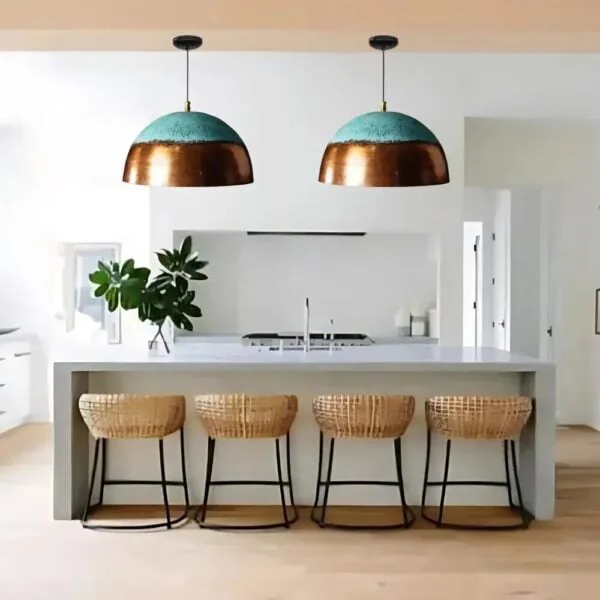

A pair of verdigris and copper dome pendants illuminating a modern kitchen island
A pair over an island. Even spacing, same fitting, one gesture.
Two gold hammered dome pendants hanging above a modern dining table
Solid shades throw light down rather than out – a different tool from a pierced shade.

Shadow: the part that has to be designed

A pierced fitting projects. Whether that projection is spectacular or invisible comes down to four decisions, none of which are about the fitting itself.

Give the pattern a surface

Shadow needs somewhere to fall. A sconce mounted on a wide plain wall throws a full pattern; the same sconce squeezed between a window reveal and a cupboard throws it onto nothing. When you place a pierced fitting, look at what is around it, not just at the fitting.

Choose the lamp deliberately

The lamp inside the shade decides how sharp the pattern is. A small, bright, clear source throws crisp defined shadows; a large or frosted source softens them into a wash. Neither is better – but the choice should be made, and it should be made before the fittings are ordered, because the same shade can produce two entirely different rooms.

Control the ambient light around it

Projected pattern is a low-contrast effect. Put it in a brightly and evenly lit room and it disappears. This is a control issue as much as a design one: if the decorative circuit and the general circuit dim together, the effect never has a moment to exist. Separate them.

Think about the whole day

A hospitality space changes character between breakfast and midnight. The pierced fitting that is nearly invisible at noon becomes the defining feature of the room at nine in the evening. Design the scheme so that transition is deliberate, and make sure the evening scene is the one the fitting was chosen for.
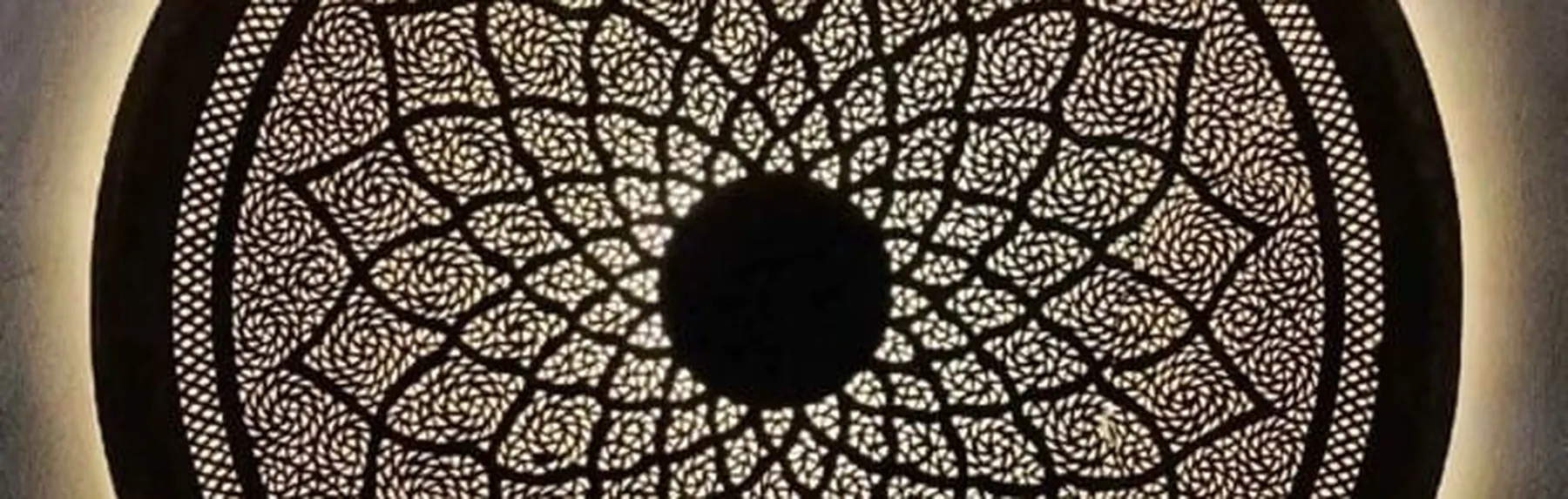
A hand-pierced brass wall light casting a radiating mandala of light across a dark wall
The fitting is the object. The pattern it throws is the design.
Craft of Medina

Which format for which space

Lobby and reception

Scale and singularity. One large pierced pendant or a disciplined cluster in a void, with the general lighting kept low enough that the pattern registers. Sconces flanking a reception desk give the face of the desk a rhythm without adding clutter to the ceiling.

Restaurant and bar

Pendants in a line over the bar and over long tables, with solid or partly solid shades where light needs to land on the food rather than on the ceiling. Reserve the openwork pieces for the perimeter, where the pattern can hit a wall.

Guest rooms and suites

This is where the pierced fitting does its best work, because the guest is stationary, the room is small and the walls are close. A pierced bedside lamp throwing pattern across a wall is the detail people photograph. Consider it alongside the rest of the room – a wool rug underfoot and a warm surface finish will do more with that light than a hard, flat scheme.

Corridors and circulation

Sconces at regular intervals, each throwing pattern onto the wall between them, turn a dull corridor into a rhythm. This is one of the highest-value moves available in a hotel, because corridors are usually the least considered spaces in the building.

Terraces and courtyards

Outdoors, projected pattern has fewer surfaces to land on, so lanterns and fittings that read as objects in their own right tend to work better than openwork designed to project. Exterior locations also carry their own requirements – confirm suitability for the specific position with your supplier and the project’s electrical consultant.

Coordinate early with the lighting designer

Decorative fittings are usually specified by the interior designer and the scheme by a lighting consultant, and the two packages frequently meet too late. Share the actual fittings early – the shade, the perforation, the intended lamp – so the general lighting can be planned to leave room for what they do.

Finish, briefly

Brass is not one finish. Polished, hammered, blackened, verdigris and copper all read differently in a scheme and, more importantly, age differently over the life of a hotel. That decision deserves its own consideration – we set it out in brass finishes for Moroccan lighting.

Our lighting collection covers pendants, sconces, table and floor lamps and lanterns, all hand-pierced and hand-hammered in our own workshops – which means scale, perforation density and finish can be developed for a project rather than selected from a fixed range.

How many pendants should hang over a table or bar?

Fewer, larger fittings almost always beat more, smaller ones. Work from the length of the surface and centre the arrangement on it, keeping the spacing identical between fittings. An odd number reads as composed; an even number reads as ordered. Both work if the spacing is disciplined.

Will a pierced fitting give enough light for a dining room?

Treat it as a decorative layer rather than the working light. Pierced fittings create atmosphere and pattern; the light that lands on a table usually comes from elsewhere in the scheme. Plan both together rather than asking one fitting to do both jobs.

Can these fittings be made to a custom size?

Because the pieces are hand-pierced and hand-hammered rather than tooled, scale and pattern density can be developed for a project. That is generally the right approach for a large void or a bespoke joinery condition where a standard fitting would be under-scaled.

Enquiries

Scale it to the space,
not to the catalogue

Send us the ceiling heights, the elevations and the rooms. We will propose fittings at the right scale – from the collection, or developed in our Fès workshops for the project.