
Specify a brass fitting and you are making two decisions at once: what it looks like on the day it is installed, and what it will look like after several years of a building being used. Those are genuinely different questions, and brass is one of the few materials where the second one is interesting rather than merely a risk.
The vocabulary is also used loosely across the trade – antique, aged, burnished, bronzed – so it is worth being precise about what is actually being described.
The finishes, and what each one does
Polished brass
Bright, warm, reflective, unmistakably gold. It puts the most light back into a room and reads as the most formal of the finishes. On a hand-hammered or hand-engraved piece, polishing emphasises the working of the metal, because every facet catches a highlight.
What to expect over time: brass is a living metal, and left uncoated it darkens. A polished finish is therefore the one most likely to be supplied with a protective coating – which is a question to ask rather than assume.
Hammered brass
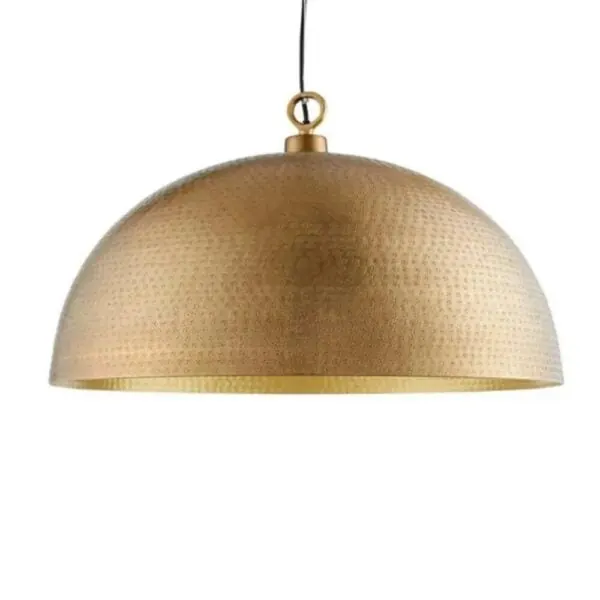
The surface is worked with a hammer so it holds hundreds of small facets. Visually it is the opposite of a flat sheet: light breaks across it instead of reflecting cleanly, which softens a large form considerably and makes a big dome or pendant feel less heavy.
It is also the most forgiving finish in a working building. Marks, fingerprints and the ordinary knocks of a hotel corridor do not register on a surface that is already textured.
Antique or aged brass
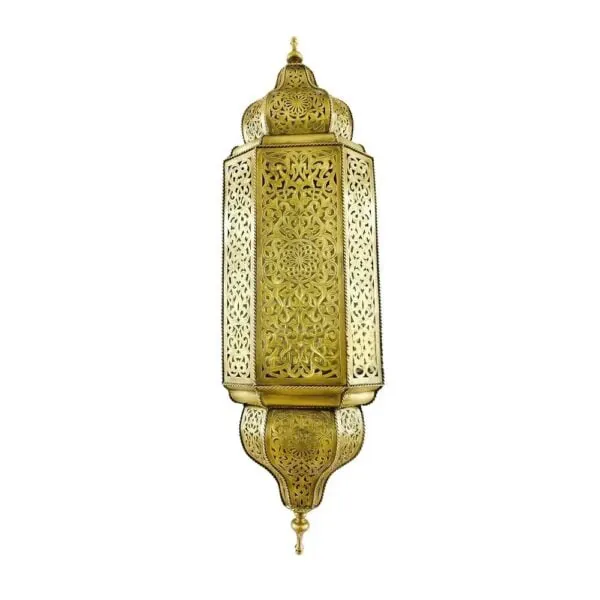
Brass darkened deliberately at the workshop, so the piece arrives already carrying depth rather than reaching it over years. The recesses of an engraved or pierced pattern go darker than the raised surfaces, which makes the pattern read more strongly – a real advantage on a heavily worked piece.
For hospitality this is often the most practical choice: it looks settled from the first day, it does not announce every mark, and it ages by continuing in the direction it has already started.
Blackened brass
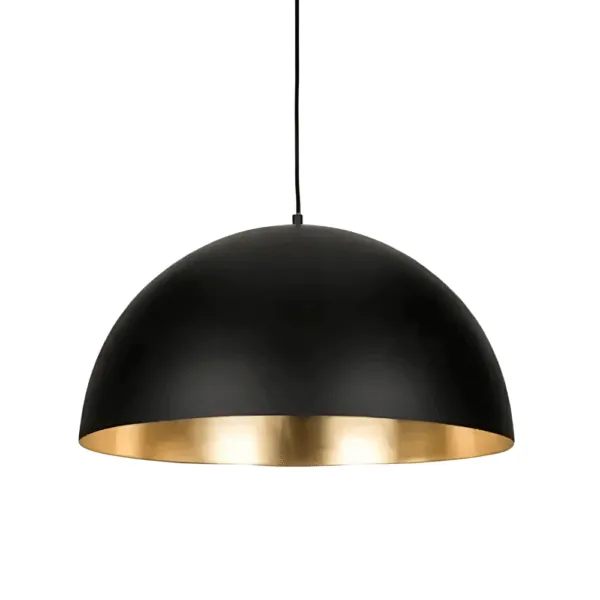
Taken further, to a dark, matt, almost graphic surface. It turns a pierced fitting into a silhouette when unlit – and when lit, the contrast between the dark shade and the light escaping through the perforation is at its strongest.
Pieces with a dark exterior and a bright interior exploit this deliberately: the fitting reads as a dark object in the room and as a pool of warm light beneath it.
Verdigris and copper
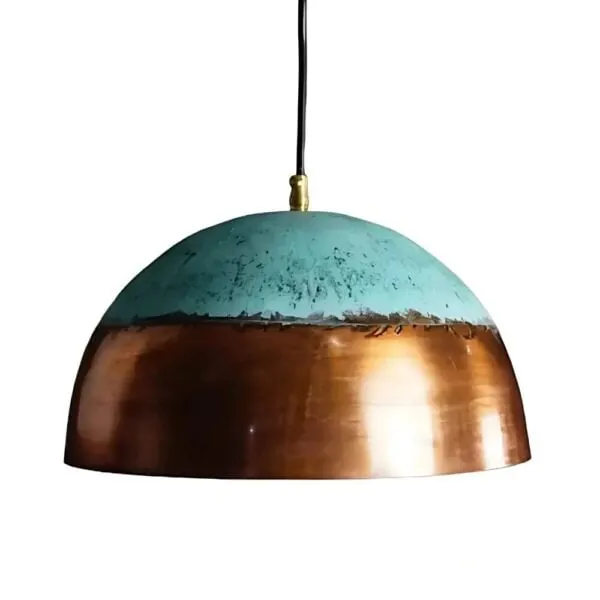
The green-blue patina of weathered copper alloy, and the warm pink-brown of copper itself. Both sit further from the conventional gold of a hospitality scheme, which is exactly why they are useful – they read as found or inherited rather than newly specified, and they combine unusually well with terracotta, plaster and unbleached wool.
The question behind all of them: living finish or fixed?
Uncoated brass reacts with the air. It moves from bright gold toward honey, then amber, then a deeper brown, and it does so unevenly – faster where hands touch it, slower where they do not. This is what is meant by a living finish, and in a building it means a fitting slowly becomes specific to its position.
A coated fitting holds its appearance instead. The trade-off is that the coating is doing the work rather than the metal, and coatings have a finite life of their own; when one eventually wears or fails, it tends to fail in patches.
Neither is the correct answer in the abstract. What matters is that the choice is deliberate:
- Choose a living finish when the scheme wants a building that ages – a riad, a restaurant with a crafted identity, anywhere patina is part of the intended story.
- Choose a stable finish when the operator expects fittings to look consistent across a large estate, or when pieces in the same room must match years after some of them have been replaced.
- Confirm which you are getting. This is the single most useful question to put to any brass supplier, and it should be recorded in the specification rather than discussed verbally.
Ask three things before you specify
Is the finish coated or uncoated? How is it expected to change over time in the project’s environment? And what cleaning is recommended – particularly what should never be used on it? Put all three answers into the maintenance manual, alongside the tile and rug guidance.
A note on humid and coastal environments
Brass behaves differently in a humid coastal climate than in a dry inland one, and much of the GCC is both humid and coastal. Salt-laden air accelerates the natural change in an uncoated surface, and the rate varies enormously with position: a sheltered interior corridor is a very different environment from a shaded terrace, which is different again from a poolside cabana.
The practical response is to be specific rather than general. Tell your supplier where each fitting is actually going – interior, covered exterior, exposed exterior, near water – and take guidance per location rather than applying one finish across the whole schedule. Exterior positions should also be confirmed for suitability with the project’s electrical consultant, which is a separate question from the finish.
Matching finishes across a scheme
Decorative lighting rarely arrives alone. There will be ironmongery, sanitaryware, joinery detail and furniture trim in the same room, frequently from four different suppliers, and “brass” from each of them will not be the same brass.
Three habits prevent the problem:
- Compare physical samples side by side, in the project’s own light, before anything is approved. Brass is impossible to judge on a screen.
- Decide whether you want a match or a family. An exact match across suppliers is difficult; a deliberate family of related warm metals is achievable and usually reads better.
- Consider ageing, not just appearance. Two finishes that match today will diverge if one is coated and the other is not. That divergence is where mismatches usually appear.
Our lighting collection is hand-hammered, hand-pierced and hand-engraved in our own workshops, so finish can be developed against the rest of a scheme rather than accepted as a fixed catalogue option. If you need a fitting to sit beside a particular ironmongery or a particular glaze colour, send both and let us work to them.