
The short answer
Zellige is made as a wall material. It can go down in small, contained, low-traffic floors where the client understands they are specifying a handmade surface that will show its life. For anything that carries real footfall, the Moroccan floor tile is bejmat – a thicker, kiln-fired terracotta made for exactly that job.
This question usually arrives after someone has fallen for a zellige wall and wants to continue it across the floor. It is an understandable instinct and occasionally the right one, but it deserves more than a yes or a no, because the answer depends almost entirely on which floor you mean.
What a floor actually asks of a tile
A wall is looked at. A floor is walked on, dragged across, dropped on, scrubbed, and in a hotel it takes suitcase wheels and service trolleys as well. The demands are different in kind, not just in degree:
- Point loads. A chair leg, a stiletto heel, a trolley wheel concentrates weight into a very small area.
- Abrasion. Grit carried in on shoes acts like sandpaper across a glazed surface, and it works on the high points first.
- Flatness underfoot. A wall can undulate pleasantly. A floor that undulates becomes something people feel through their feet and, in a commercial setting, something the operator has to think about.
- Cleaning regime. Floors get wet-mopped daily with whatever the housekeeping contract specifies, which is a harsher life than a wall ever has.
Zellige is not built around those demands. It is built around surface – the hand-cut edge, the glaze that catches light differently on every tile. Those are wall virtues. Put them underfoot in the wrong room and you are asking a material to do something it was never developed to do.
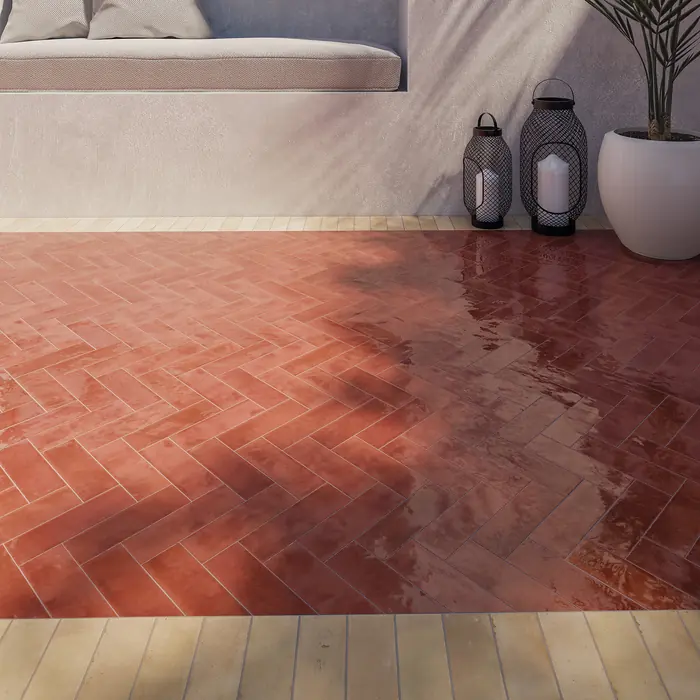
Where zellige underfoot does work
There is a real set of floors where we would specify it without hesitation, and they have a pattern in common: small, contained, and not on the main circulation route.
Powder rooms and cloakrooms
A guest WC sees a handful of people an hour at most, has no trolleys and no furniture dragging across it. Running the wall tile down onto the floor here produces the single-material, wrapped-surface effect that makes a small room feel considered rather than leftover.
Shower floors and bath recesses
Small format tile is genuinely useful on a shower floor, because it can follow a fall to the drain without cutting every tile into wedges. This is a case where zellige earns its place on the horizontal, though it belongs in a wider conversation about how the whole wet area is put together.
Risers, thresholds and steps
A stair riser is a vertical face that happens to live in a floor package. Zellige on risers with a robust tread material above is a long-standing Moroccan combination and one of the most reliable ways to bring colour into a circulation space without putting the glaze under traffic.
Inset panels and rugs in a harder floor
Setting a panel of zellige into a field of stone or terracotta – a threshold mat, a rug of pattern under a console, a border around the edge of a courtyard – keeps the material where people look and away from where they walk.
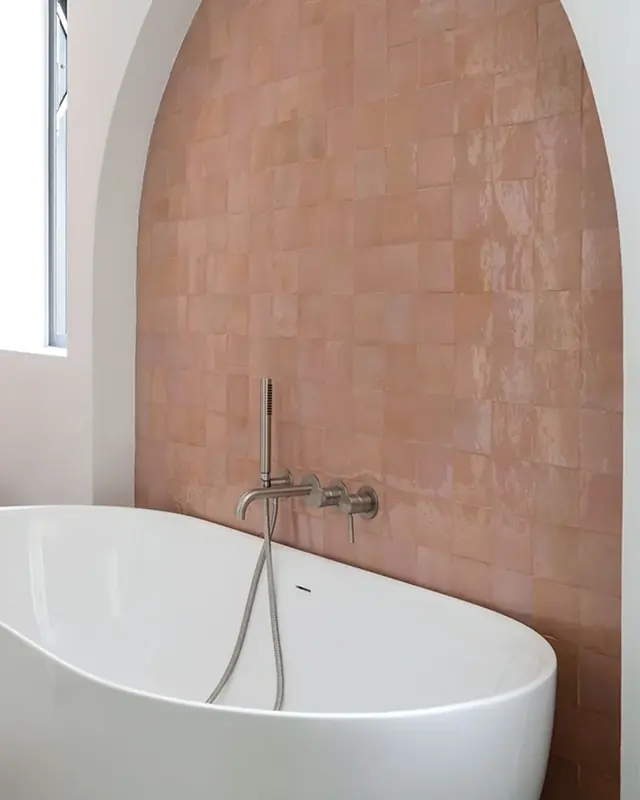
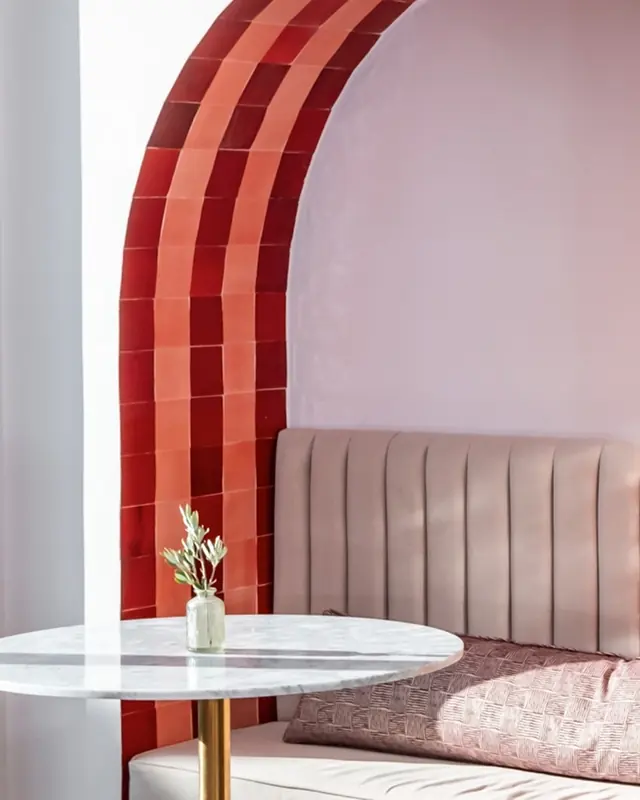
Where to say no
We would steer a client away from zellige flooring in all of the following, and it is worth having the list ready before the question is asked:
- Lobbies, corridors and any luggage route. Wheeled loads and continuous traffic.
- Restaurant and bar floors. Chairs move constantly, spillage is constant, and the cleaning regime is aggressive. Bejmat is the answer here.
- Kitchens and back of house. Grease, heat, heavy cleaning chemistry and trolleys.
- Large open floor plates. Beyond a certain area, the variation that makes a zellige wall beautiful starts to read as an uneven floor.
- Anywhere slip performance is being formally assessed. That assessment belongs with the project consultant and the specific material being proposed, not with a general rule of thumb.
If the client insists on one material throughout
There is a better move than compromising the floor: change the relationship instead of the material. A few approaches that keep the scheme coherent without putting a wall tile under traffic –
- Match the colour, change the body. Glazed bejmat comes in the same colour language. A bejmat floor in a tone that answers the zellige wall reads as one family, and the change of format is legible as a deliberate decision.
- Let the floor be quiet. A plain terracotta or stone floor under a strong zellige wall gives the wall somewhere to sit. Two loud surfaces in one small room tends to cancel both.
- Wrap vertically, not horizontally. Take the zellige up and over – onto the ceiling of a niche, around a column, across a bar front – instead of down. It reads as immersive without touching the floor build-up.
None of this is a limitation of the material so much as a description of what it is. Zellige has been used on Moroccan walls, fountains, columns and risers for centuries, and on Moroccan floors it has had a companion tile for just as long. Specifying both, each where it belongs, is the traditional answer as well as the durable one.